
October 15, 2026
Five Benefits of a Shared Bitcoin Wallet
Taking custody of your bitcoin can be anxiety-inducing.
We offer Community Custody as a way in which the risk and responsibility is distributed amongst a handful of people as opposed to just yourself. Think of it as a shared bitcoin wallet that comes with benefits that make it far more dynamic than your standard self-custody set up.
This type of shared Bitcoin wallet we’re referring to is a Fedimint Federation that is controlled by a small group of trusted people called “Guardians.”
These Guardians hold the keys to the Federation in a multisignature (multisig) bitcoin wallet, which is a bitcoin wallet with multiple keys, on behalf of their family, savings club, or community. The Federation then mints an ecash equivalent for its users and enables them to spend funds near instantly via the Lightning Network (Lightning).
Fedimint Federations are the only type of wallet that offers multisig-style security with Lightning- and ecash-level usability.
In this article, we’ll cover five benefits of holding bitcoin this way:
No Solely Responsible Entity
No Company Controls Your Money
The Guardians Secure the Community Bitcoin
Privacy
Secure Savings Are Easy to Spend
We'll start with the benefit that underpins all the others: the distribution of risk among multiple key holders.
1. No Solely Responsible Entity
Most self-custody wallets rely on one key, backed up by one seed phrase, held by one person. If you lose that seed phrase, have your phone compromised, or make one wrong move, your bitcoin can be gone for good.
A Federation makes it so that no single person, device, or seed phrase can move the funds. At least four Guardians each run a Fedimint node, and moving bitcoin out of the Federation's multisig wallet requires more than two-thirds of them to collaborate. One Guardian losing a key or going rogue isn't enough to drain the wallet.
As we explain in Self-Custody Bitcoin Wallets Versus Community Custody Fedimint Federations, this idea of a shared Bitcoin wallet maintains self-custody's core promise while removing its biggest weakness, the single point of failure.
2. No Company Controls Your Money
When you leave bitcoin on an exchange, what you hold is a balance on a screen and a promise that the company will give you bitcoin when you ask for it.
That promise has broken many times. From the Mt. Gox hack in the early days of Bitcoin to the more recent collapse of FTX, many Bitcoin enthusiasts have learned the hard way why it can be dangerous to leave your keys in the hands of an exchange.
In a Federation, there's no company in the middle. The keys are spread across Guardians you know and trust, and you can withdraw your sats (fractions of a bitcoin) at any time either over Lightning or on-chain, to a wallet of your choosing.
3. The Guardians Secure the Community Bitcoin
Think of the people in your life who are never going to stamp up to 24 words onto steel and guard them for decades.
Community custody, or a shared bitcoin wallet, meets them halfway. The Guardians handle the demanding parts: running nodes, safeguarding their keys, and keeping the Federation online. Everyone else simply uses the wallet.

This is also what sets community custody apart from collaborative custody models like Casa or Unchained. With those services, you typically remain the holder of two or more of the keys in a multisig quorum and carry part of the burden yourself. In a Federation, you don't, and you don't pay a yearly subscription fee for the service either.
4. Privacy
Opening an account on a Bitcoin or crypto exchange means turning over your name, address, and ID documents.
Buying a hardware wallet usually means sharing your name, address, and email.
That data can leak, as it did when support agents at Coinbase who were bribed exposed customer information and when one of Trezor's shipping providers was breached.
With physical attacks on bitcoin holders on the rise, a leaked customer list can quickly become a target list.
Fedi CEO Obi Nwosu commented on this dynamic in a recent talk he gave.
“Because I ran a regulated exchange, I had to hold one of those customer lists, so I know all too well that a customer list is a target list,” said Nwosu. “The only list that doesn’t leak is the one you never collect.”
Your information can’t leak when you join a federation, because a Federation doesn't require any of your personal information.
And because payments inside a Federation are made in ecash, even the Guardians can't see who is paying whom. That is, your transactions aren't broadcast to a public ledger or logged against your identity.
5. Secure Savings That Are Easy to Spend
With self-custody, you usually have to choose between cold storage and/or multisig, which are secure but slow. Lightning wallets are fast, but typically rely on a single hot key that lives on your phone.
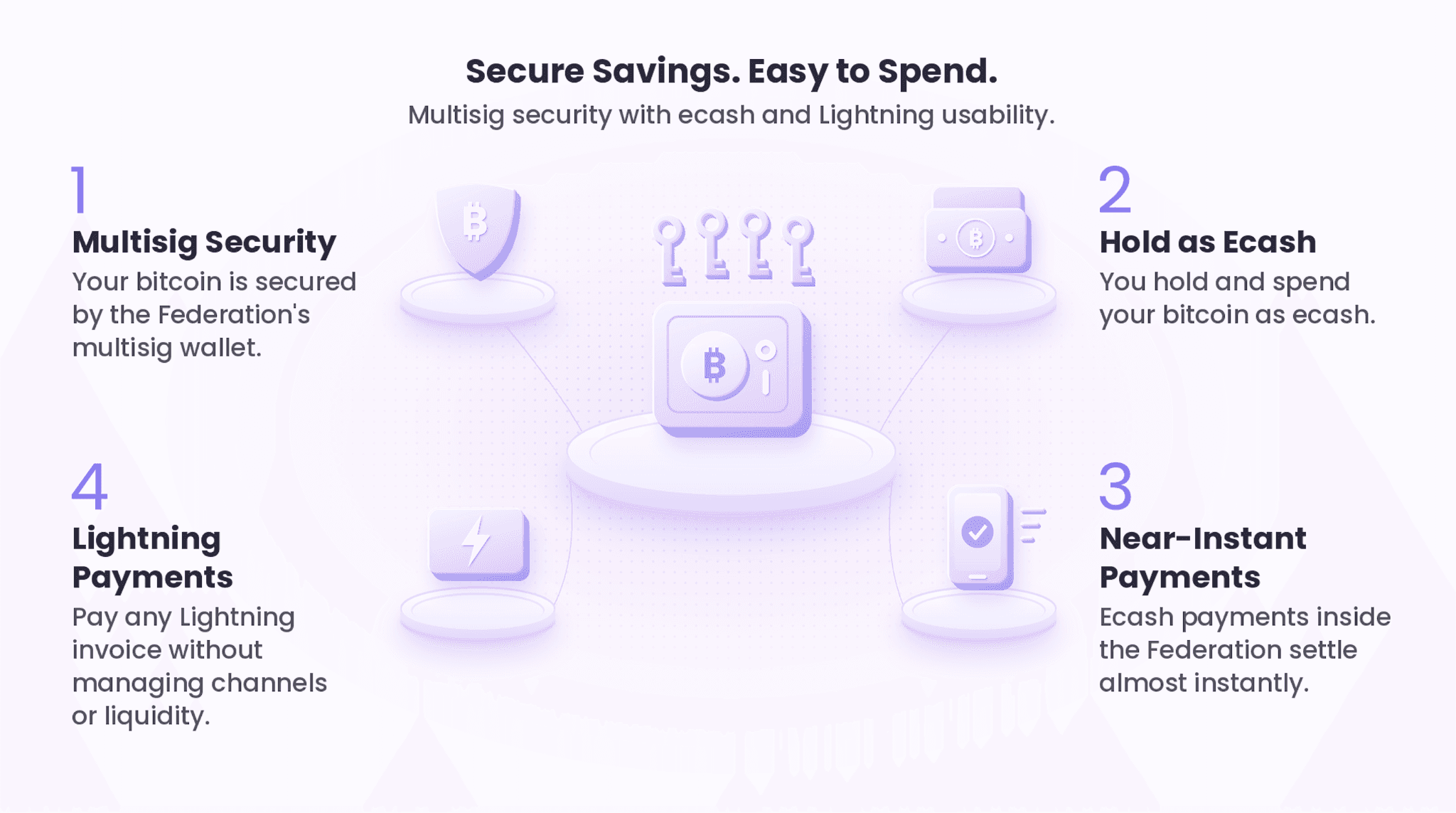
A Fedimint federation removes that choice. Your bitcoin is secured by the Federation's multisig wallet, while you hold and spend it as ecash. Payments inside the Federation are near-instant, and you can pay any Lightning invoice without managing channels or liquidity yourself.
With Fedi you also get other benefits built upon the federation: Stable Balance lets you peg part of your bitcoin balance to a fixed fiat value, while Multispend lets families and groups save together and vote on how shared funds are spent.
Some Honest Caveats
Community custody asks you to trust the Guardians not to collude, not to lose their keys, and not to issue more ecash than the bitcoin the Federation holds.
Also, you must trust that Guardians will keep their nodes online, since funds freeze if too many nodes go offline. This is one of the reasons why EcoBitz’s Kelvin Makini spends from a federation for which he knows the guardians.
And like any wallet, a Federation is only as sound as the software it runs on, a risk highlighted by the recent Coldcard hack and Liquid Network exploit. Even Nwosu has been candid in that this critique applies to Fedimint, too, which until recently ran on a single implementation. As he recently wrote in Bitcoin Magazine, developers have since run a single Federation across three independent implementations at Ecash Hackday in Berlin, Germany, so that one bug can't take down every Guardian at once. Fedimint creator and Fedi co-founder Eric Sirion has made the case for implementation diversity, as well.
Try a Shared Bitcoin Wallet
Every custody decision comes down to one question: who holds the keys? Hold them alone, and you carry all the risk. Hand them to a company, and you have to trust the company to remain solvent and to deliver those bitcoin when you request them.
A shared bitcoin wallet spreads that responsibility across people you trust. It removes the single point of failure, removes the notion of a third party getting between you and your money, leaves the technical work to the Guardians, protects your privacy, and makes your savings easy to spend.
Ready to give community custody a try? Download the Fedi app and join a Federation.
