
August 24, 2026
EcoBitz: Environmentalism Meets Bitcoin in Kenya
“Environmental conservation is a matter of self-responsibility. I can do something productive with my waste and take responsibility for it, not just throw it away. It’s the same with Bitcoin. It's about personal responsibility — not your keys, not your coins. There’s alignment between Bitcoin and environmentalism, for real.” -Kelvin Makini, founder of EcoBitz
In November 2023, Kelvin Makini returned to his hometown of Mitaboni, Kenya, with a degree in electrical engineering but few job prospects, as the market for work in his trade was cold.
During this downtime, Makini noticed an unsettling trend in Mitaboni: the town had grown accustomed to the glass bottles strewn about the streets.
This didn’t sit right with him.
He opted to do something about it.
“I was moved to start recycling because no one else was doing it,” Makini told me in an interview. “People were just leaving their glass bottles in the streets, and I thought to myself, ‘What can I do about this?’”
He began to wake up early in the morning and collect all of the bottles he could find around town. He eventually acquired upwards of 20 sacks of glass and was running out of space to store them.
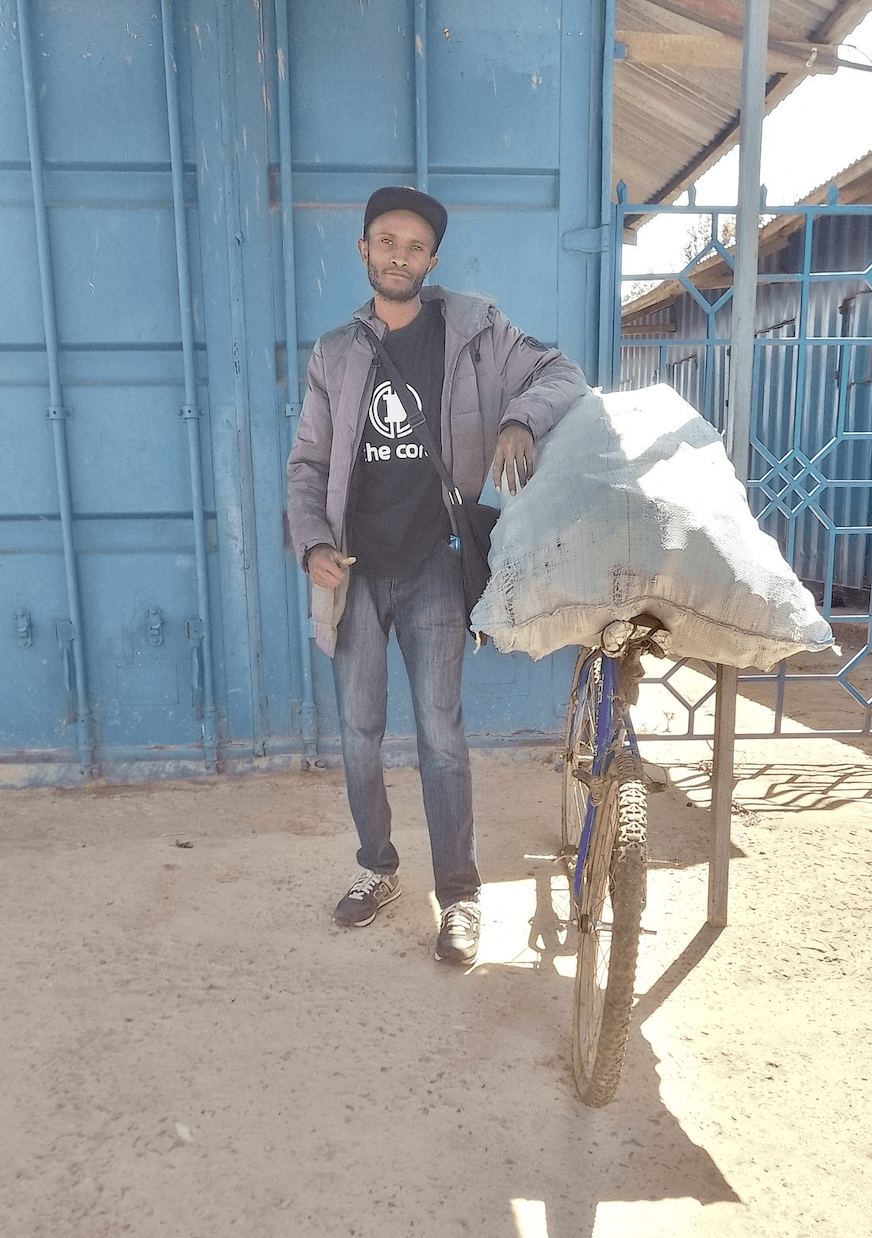
Makini with a sack of glass bottles | Photo courtesy of EcoBitz
After approaching a handful of recycling companies, one eventually came to collect the sacks, paying Makini a fee in the process.
In the wake of this transaction, a light went off in Makini’s mind.
There was an opportunity here, albeit one that wasn’t fully fleshed out.
With a little bit of time, Makini cracked the code — and the answer included a broader plan and a better money.
How EcoBitz Was Born
Not long after Makini returned to Mitaboni, he partook in another educational experience.
This one wasn’t quite as formal as the university experience, but it was perhaps more profound in some ways.
Makini had begun researching a native internet money he’d read about a few times while at university — Bitcoin — and, in doing so, he came into contact with Felix Mukungu and the team at The Core, a Bitcoin education nonprofit based in Kenya.
“Felix was able to guide me through the My First Bitcoin diploma,” explained Makini. “That was where I started with Bitcoin.” (Makini would later be featured in the My First Bitcoin-sponsored documentary below.)
Soon after, Makini began to incorporate bitcoin into the recycling program, paying the recyclers on his growing team in sats — 21 sats per bottle they’d collect, to be exact.
At this point, Makini’s team had begun not just picking up glass in the streets but from landfills as well as from clubs, shops, and bars that served beverages in glass bottles. He’d pay the owners of these establishments in bitcoin for the glasses.
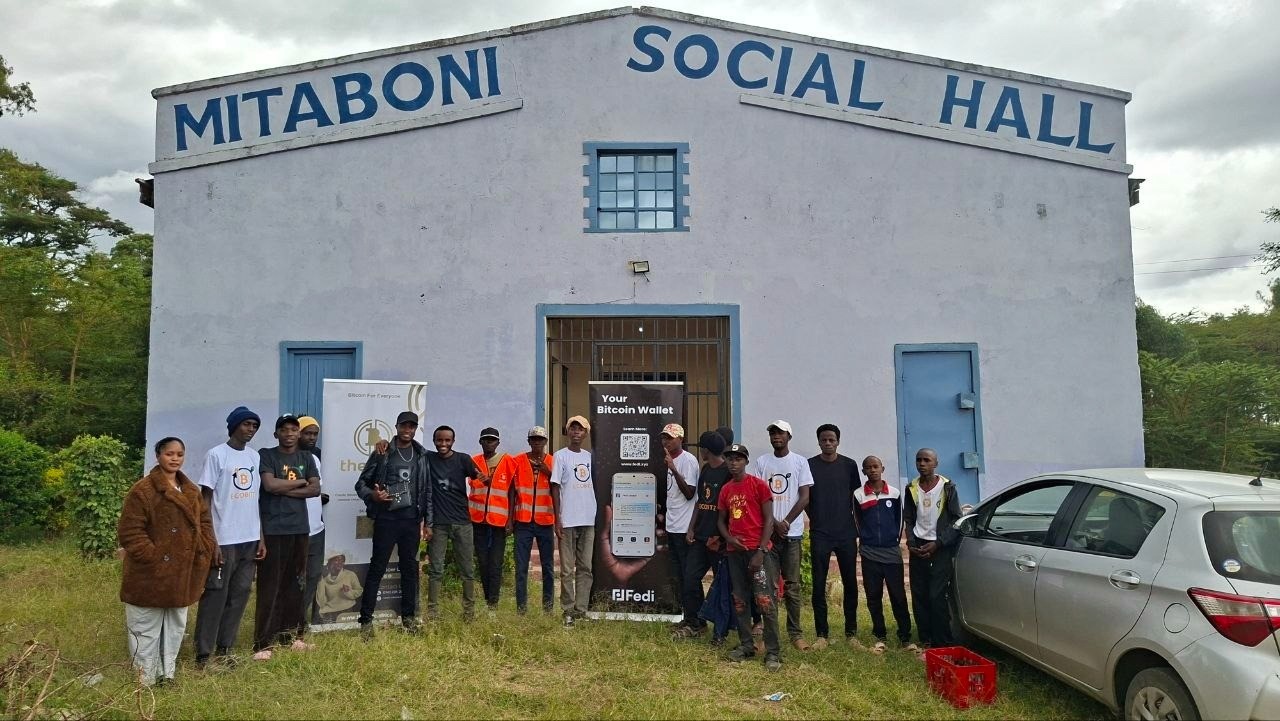
Mukungu and Makini (fifth and sixth from the left) and team members from EcoBitz and The Core at the Mitaboni Social Hall | Photo courtesy of EcoBitz
“This is how the circular economy in Mitaboni came into existence,” said Makini.
And in the process, Makini came up with a name for the project. After consulting with his mentors at BitBiashara, an organisation that educates entrepreneurs and small business owners about Bitcoin, and Afribit, a Bitcoin circular economy project based in Kibera, East Africa’s largest informal settlement, the name for the project came to Makini — “EcoBitz.”
“I wanted a name that aligned with both the environment and Bitcoin,” explained Makini. “‘Eco’ is for ecosystem, in the environmental sense, and ‘Bit’ is for ‘Bitcoin.’”
And so EcoBitz — a “waste-to-bitcoin” initiative — was born.
Why Bitcoin?
Some might say Bitcoin isn’t entirely necessary for EcoBitz’s operations.
After all, Makini was initially paid by the company that took his first 20 sacks of glass off his hands in Kenyan shillings (KES), Kenya’s national currency.
According to Makini, though, using bitcoin serves a number of purposes, the first of which is fighting inflation.
“I used to make a profit of 2 KES for each bottle, but inflation kept biting away at the small amount of money I made,” explained Makini. “Using bitcoin, the value of my labor will be preserved into the future.”
Makini also noted that the fees for transacting in bitcoin over the Lightning Network tend to be lower than transacting over M-Pesa, a mobile phone–based money transfer service that’s popular in the country.
Additionally, M-Pesa requires that users have a national ID, something that not everyone in Kenya has and something that using Bitcoin does not require.
Finally, Makini shared that some recyclers still prefer payment in fiat but that this has been slowly changing.
“When the recyclers realise that Bitcoin is different from fiat currencies, they gradually begin to prefer sats,” said Makini.
Upcycling
Since its inception, EcoBitz has gotten more creative. It doesn’t just hand over the glass that it collects to recycling companies anymore.
It’s begun to upcycle bottles that aren’t broken, cleaning, polishing, and stylising them to create finished products that they can sell.
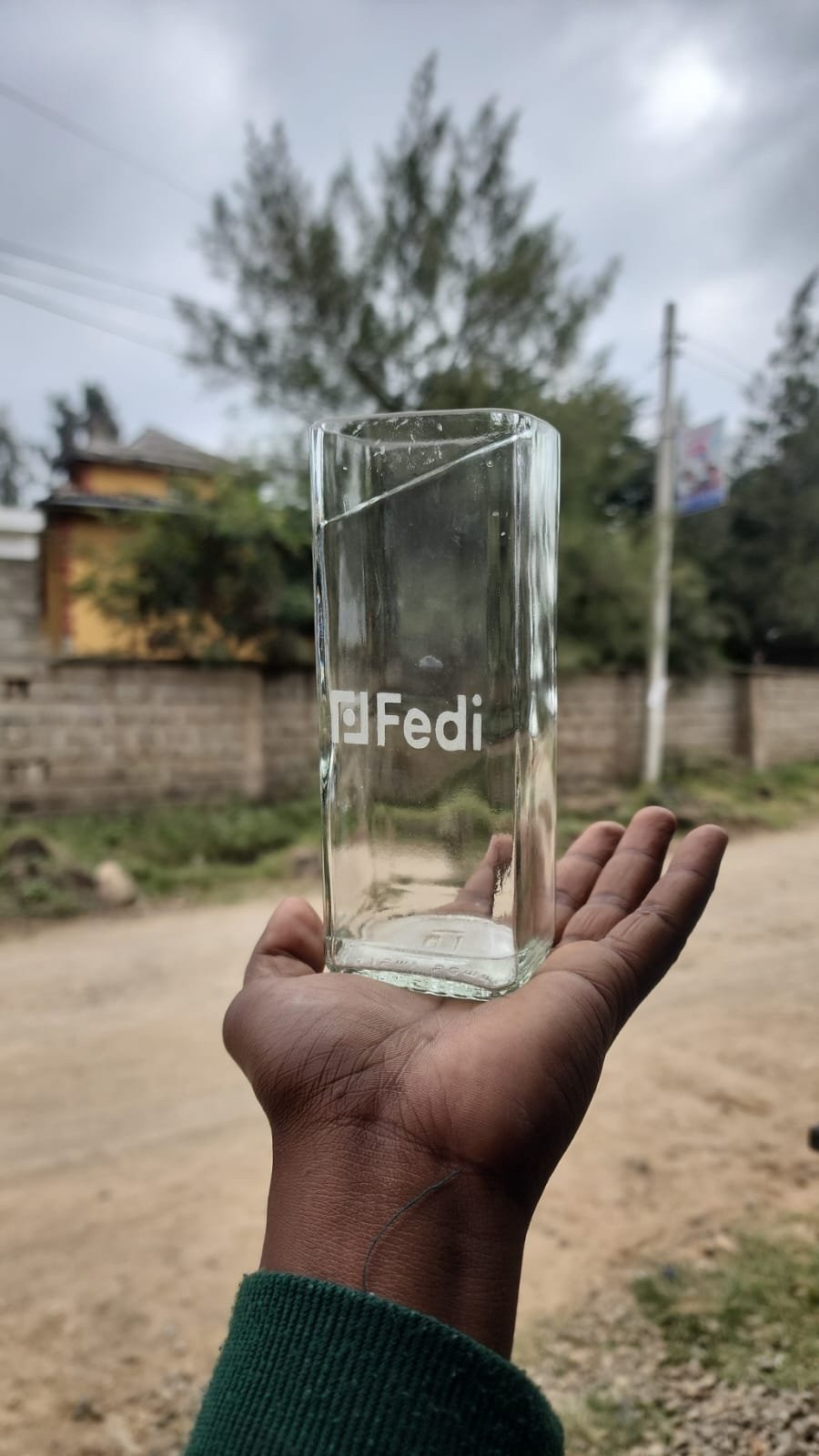
Upcycled glassware from the EcoBitz community | Photo courtesy of EcoBitz
To produce glassware such as the piece above, as well as other products such as drinking glasses for the home, Makini travels to Nairobi to a shop that upcycles the glass and does the branding on it.
To get this work done, Makini travels three hours by bus from Mitaboni to Nairobi. His dream is to one day purchase the machinery he needs to do this type of work himself.
“If we had the machine, we'd be having so many people coming to Mitaboni just to get their glasses cut and pay in Bitcoin,” explained Makini.
“Don’t get me wrong — we are so privileged to have access to a machine that does this, because it’s not that far away, but if we had the machine here in Mitaboni, we could progress so much. We'd be able to produce more products,” he added.
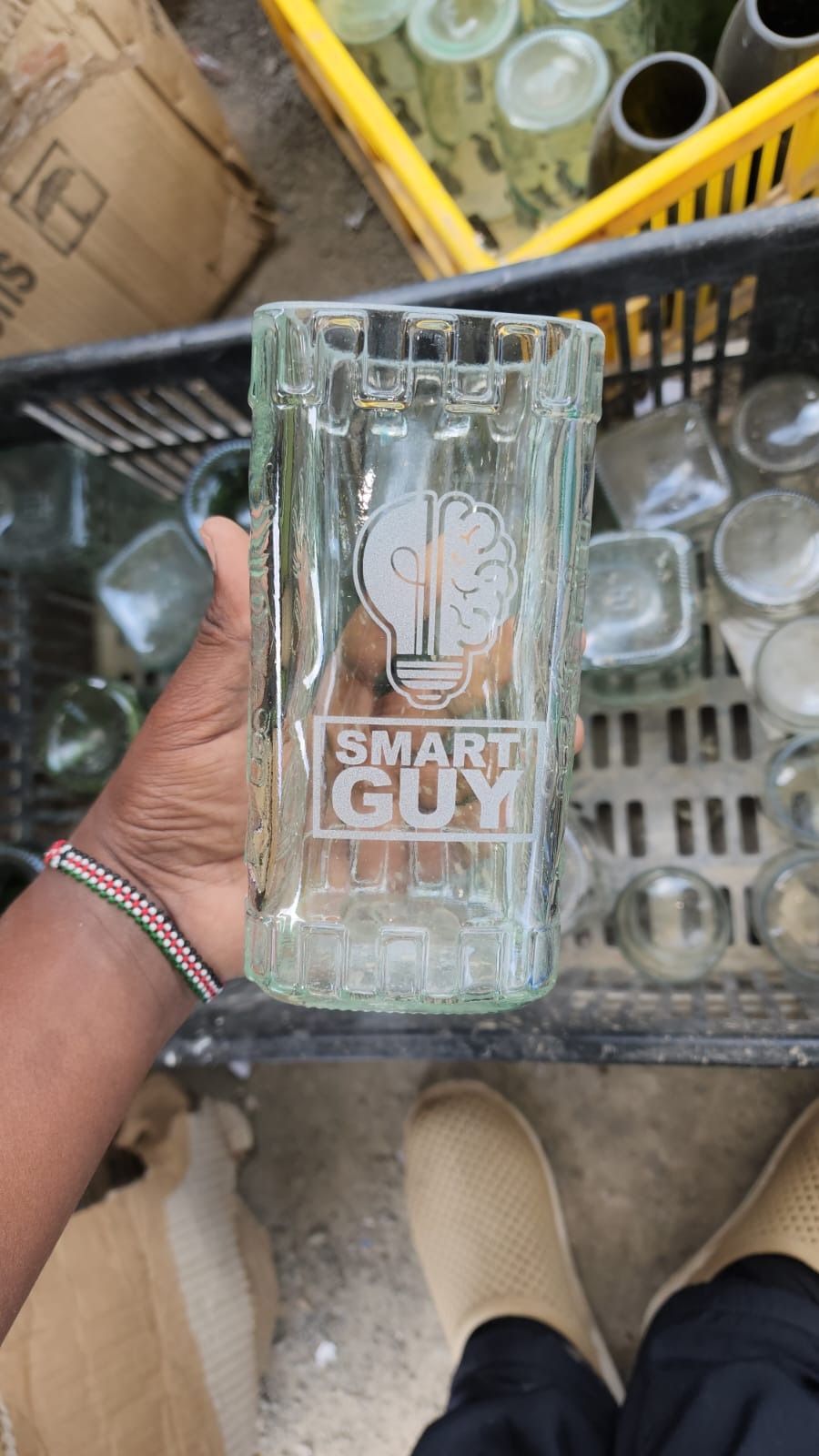
A “Smart Guy” EcoBitz glass | Photo courtesy of EcoBitz
EcoBitz Showcases and Sells Its Goods at Bitcoin Nairobi
The EcoBitz team showcased some of their work at this year’s Bitcoin Nairobi Conference at the Fedi booth.
“We were proud to display our glassware at the conference alongside the beautiful tote bags and purses from Afribit’s upcycling initiative,” said Makini.

Photos from the Fedi booth at Bitcoin Nairobi, where the EcoBitz team sold its wares | Image courtesy of EcoBitz
“Plus, when individuals turned up at the booth to view the beautiful products displayed and grab a few of them, this gave us a chance to introduce them to Fedi, which makes it easy to spend bitcoin and for communities, families, organizations and individuals to save, manage and use bitcoin together,” he added.
“We created and tested their Fedi wallets, and some of the amazing attendees at the conference even purchased upcycled glassware and paid in Bitcoin directly to our Fedi wallet through Afribit Kibera federation.”
How the EcoBitz Team Uses Fedi
Makini also noted that he and the EcoBitz team often spend sats via the Afribit Kibera federation on Fedi.
He said that he’s comfortable using the Federation because he and his team are familiar with Afribit and that they “can easily access the Guardians in case of technical challenges.”
What is more, Makini shared that EcoBitz has an active Community space on Fedi.
“The recycling initiative has been utilizing the space to update price changes for recyclables and to make payments to recyclers,” said Makini. “A recycler can create an invoice and share it in the space.”
Makini believes that more and more entrepreneurs from his community will gravitate towards Fedi as a tool for bitcoin payments, for holding bitcoin as a treasury asset for their business, and for building community.
He also noted that the EcoBitz team plans to begin using Fedi’s Multispend feature to create a shared treasury mechanism.
“Using Multispend will be a great step towards ensuring transparency and tracking progress, especially for the waste management initiative to manage sats generated through recycling, coordinated community cleanups, and for the network of merchants to accept bitcoin for payments and to take control of their savings in self-custody,” said Makini.
The Future of EcoBitz
Makini and his team are just getting started, and he’s crafted a clear roadmap for what comes next for EcoBitz.
First, he’d like to begin creating upcycled glassware that serves as the containers for EcoBitz’s small-scale honey farm.
“This will ensure anyone consuming the honey will be able to trace the whole process — from how the honey is harvested to how its packaging is made,” said Makini.
Makini’s broader goal is to ensure no glass waste ends up in Kenyan landfills, and the EcoBitz team is currently in the process of developing a program through which crushed cullet (waste glass) can be put to better use.
“We want to use the cullet to make house floor tiles, table bases, and other types of home décor,” said Makini.
Makini also hopes to set an example for what a Bitcoin circular economy tied to a recycling program can be.
“I would love to see it grow into a living example of what a Bitcoin circular economy can look like: recyclers getting paid in sats, spending sats to purchase basic needs, and saving sats in a common pool through Fedi’s Multispend feature,” explained Makini. “I’d like to see it extend from the Bitcoin hub where the community learns about bitcoin, to a thriving waste-to-bitcoin model that will serve as a blueprint for other communities to learn from.”
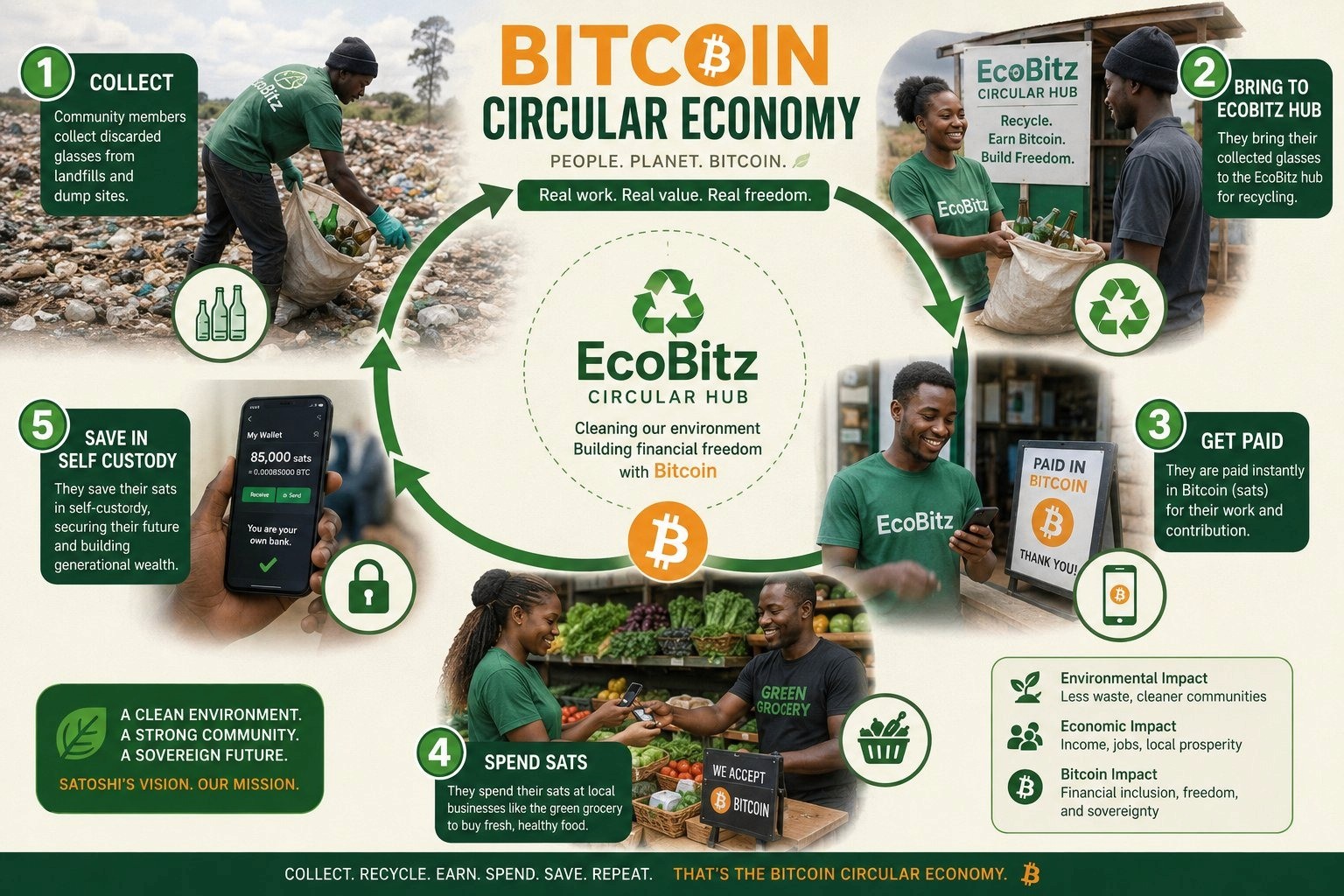
The EcoBitz Bitcoin circular economy | Image courtesy of EcoBitz
More generally, Makini is simply happy to be setting a broader example of how Bitcoin can be used to solve real-world issues.
“The most powerful part is that EcoBitz is demonstrating that Bitcoin adoption is not only about owning Bitcoin, it’s about using it to solve problems in the community, empowering individuals who in turn become ambassadors of sound money in their communities, and contribute to the success of the Bitcoin circular economies,” said Makini.
