
June 3, 2026
Vinteum Is Making Space for Brazilian Bitcoin Developers
Lucas Ferreira has been working in the Bitcoin space since soon after he discovered Bitcoin in late-2017.
And for much of that time, Ferreira, the co-founder of Vinteum, a non-profit that supports open-source builders in Brazil, has been making every effort to bring more Brazilian developers into the Bitcoin fold.
Has he been doing this because he thinks Brazilian developers are the best or that they have some secret insights into what Bitcoin needs? Not exactly.
His efforts are more inspired by the fact that global money requires a global network of developers, and he’d like to see more Brazilians become a part of that network.
“I’m not saying Brazilian developers have a special view of what Bitcoin needs, but I think they have a specific view of what it needs,” Ferreira told me in an interview.

Ferreira’s profile picture on X.
“Indians have another specific view of what Bitcoin needs. And Nigerians and Kenyans have another specific view of what Bitcoin needs and what works in their country, for their people,” he added.
“Having diversity, especially geographic diversity, will give you more perspectives and you will have developers ready to work on problems that maybe someone in the U.S., for example, won't notice.”
Wise words from a Bitcoin advocate with a background in the social sciences, someone who — luckily for the Bitcoin community — decided to abandon his academic ambitions to move into the Bitcoin space, where he felt he could have a greater impact.
The Road to Vinteum
Ferreira discovered Bitcoin soon after graduating from university with a degree in anthropology.
He had a desire to make a social impact and initially considered pursuing his PhD in an effort to become a professor. However, when he took a long, hard look at what that road to a professorship would look like, he dissuaded himself from embarking on it.
“It was actually a pyramid scheme,” recounted Ferreira. “90 people enter one doctoral program at a university, but you only have fifteen to thirty professors, and new positions only open up when these professors retire.”
Not wanting to be a part of this pyramid scheme, he turned to Bitcoin.
After learning about XRP from a friend who was a day trader, Ferreira began to study crypto, only to quickly realise that Bitcoin was the real signal.
Down the proverbial Bitcoin rabbit hole he went.
Given that there was only one big Bitcoin YouTube channel in Brazil in 2018, according to Ferreira, he started his own channel on which he interviewed other Brazilian Bitcoin enthusiasts at Bitcoin and crypto events that had begun to pop up in his home country.
One of the people he interviewed was the country manager for Brazil for the Argentinian crypto exchange Ripio. Ferreira landed a job at the company soon after and found himself headed to San Francisco, California on a business trip in June 2019.
The trip coincided with Bitcoin 2019, which was expected to be the biggest Bitcoin conference the world had ever seen at the time. Using his own funds, he extended the trip to be able to attend the event.
The conference had a profound effect on him, as did the San Francisco BitDevs Socratic seminar he attended on 24 June 2019, the evening before the first day of the conference.
It was at the BitDevs event that he met Alex Leishman, who was then the San Francisco BitDevs host (and who is now the CEO and CTO of Bitcoin exchange River).
Ferreira stayed in touch with Leishman, who would connect him with Elizabeth Stark, CEO and co-founder of Lightning Labs, in 2021.
After hosting Stark and Lightning Labs developers at a meetup while they were in São Paulo, Brazil for a team retreat, Ferreira joined the Lightning Labs team, where he learned how to better work with developers.
By 2022, he wanted to do more of this type of work through a project of his own.
And so Vinteum (“21,” in Portuguese) was born.
Establishing Vinteum
Ferreira co-founded Vinteum with André Neves, a Brazilian-born open-source developer who Ferreira had first contacted while Neves was in New York just after his Lightning Network residency at Chaincode Labs.
Ferreira found someone in Neves who had the same passion for empowering developers.
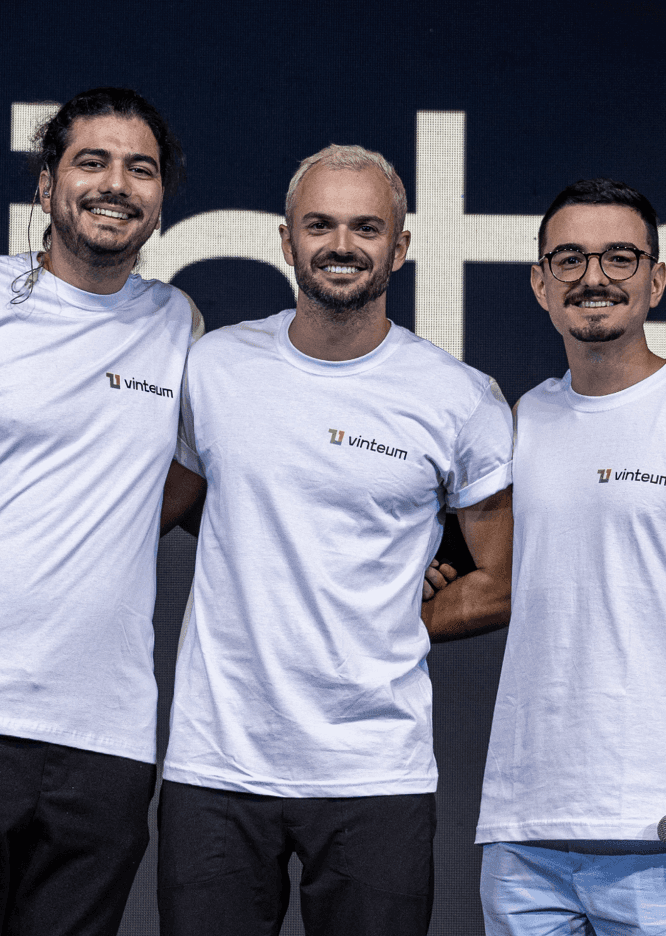
L-R: Ferreira; Neves; and Vinteum board member and head of engineering, Bruno Garcia | Photo courtesy of Vinteum’s Three-Year Report
Funding came in from Ripio co-founder Sebastian Serrano), John Pfeffer, OKX, the Human Rights Foundation (HRF), and early Bitcoin proponent and fintech entrepreneur Wences Casares.
By 2024, Vinteum was gaining momentum, so much so that Ferreira had to step back from his role at Lightning Labs. Between his work for Vinteum and the conference he’d started three years earlier — SatsConf — he was quite busy.
“I wanted to go full-time, I wanted to hire, and I wanted to have more grantees,” said Ferreira.
Casares committed to covering operational costs for four years. These costs included salaries, budgets for educational programs, and the cost of a physical space that Ferreira and his team opened in early 2024 — Casa21, located in São Paulo.

L-R: Ferreira; Fedi’s Head of Field Operations, Renata Rodrigues; Garcia @ Casa21 | Photo courtesy of Ferreira’s X account
“I always felt like in-person gatherings, meetups, and workshops were much more powerful for what I was trying to do,” explained Ferreira.
The in-person events at Casa21 range from hackathons to educational sessions for those who are new to Bitcoin and other freedom technologies.
Last month, Fedi sponsored an event at Casa21 that introduced attendees to Fedi’s app, the Fedimint protocol, and how federations work.
Fedi in Brazil
According to Ferreira half of the participants who attended the Fedi session at Casa21 last month were already familiar with Fedi, while the other half were exploring it for the first time.

Regarding the first half, Ferreira said that a number of the developers with whom he works have an interest in Fedi and that one even contributed to the Fedimint protocol for a period of time.
“I'm around developers a lot of the time, and they get very excited about the federation component of Fedi and all the technical aspects of the wallet,” said Ferreira.
That said, it isn’t only the technically-minded in Brazil who are interested in Fedi.
“If I think more broadly about what Brazilians are interested in when it comes to Fedi, I feel like the community aspect of Fedi is very much appreciated,” said Ferreira.
Ferreira recounted a Fedi workshop at SatsConf in which conference attendees were introduced to Fedi’s various features.
What he remembered most vividly was the new users being excited about the idea of being able to send funds via Fedi’s chat function.
Ferreira also noted that Fedi could be quite useful in the northern and northeastern regions of Brazil, which are less developed and where people don’t have as much access to financial infrastructure.
Remaining on Mission
Ferreira was proud to note that “more Brazilian developers keep popping up on different Bitcoin projects.”
He was also happy to share that upwards of 15 former Vinteum grantees are now working full-time in the Bitcoin space.
These developers hold positions at institutions such as Blockstream and localhost, while others are working as maintainers or leads for projects such as Bitcoin Dev Kit and Stratum V2.
And Bruno Garcia, Vinteum board member and the organisation’s head of engineering, is also a former Vinteum grantee.
He also noted that Vinteum recently launched its second Bitcoin developer launchpad, is working to develop a partnership with the University of São Paulo on a Bitcoin and open-source developer education initiative, and that it plans to continue to facilitate numerous meetups at Casa21.
Even with all of his success, though, Ferreira wants to continue to make space for more Brazilian Bitcoin developers, as he feels it’s vital to the long-term success of the protocol.
“Diversity is important because we don't know what's going to happen next year or in ten years in terms of regulations,” explained Ferreira. “We see developers being persecuted in the U.S. and Bitcoin will be less fragile if we have developers ready to take over anywhere and everywhere. If developers in the U.S. are for some reason forbidden to work, someone in Europe, Africa, or Latin America will be there.”
What is more, Ferreira also simply believes that when developers see other developers who look like them in the Bitcoin and open-source space, they’ll be more apt to start working in the space themselves.
In his final thoughts, Ferreira recounted a scenario in which Garcia, while working as a Vinteum grantee, found a small bug in a Taproot test (a Bitcoin software upgrade that went live in November 2021).
When the Vinteum team shared the news, it brought attention to the work that Brazilian developers do on Bitcoin.
“It wasn’t even something super relevant at that point — just a small bug — but we shared the news that Bruno was a Brazilian developer who found the bug with local crypto media, and Brazilians saw in the local equivalent of a CoinDesk that a Brazilian guy is contributing to Bitcoin Core,” explained Ferreira. “This might have given them the opportunity to think to themselves, ‘I could be that Brazilian, too.’”
