
July 22, 2026
Organisation Spotlight: The Bitcoin Learning Center in Chiang Mai, Thailand — Part II of III
In Part I of this series on the Bitcoin Learning Center, we covered how the co-founders of the centre, Fai and Jimmy Kostro, met and decided to start the centre. In this part, we’ll look at how the centre was built and what it facilitates.
The Bitcoin Learning Center, a four-story facility, stands tall and vibrant near the centre of Chiang Mai.
The interior of the building has a contemporary finish and the building’s numerous windows allow ample natural light into the space.
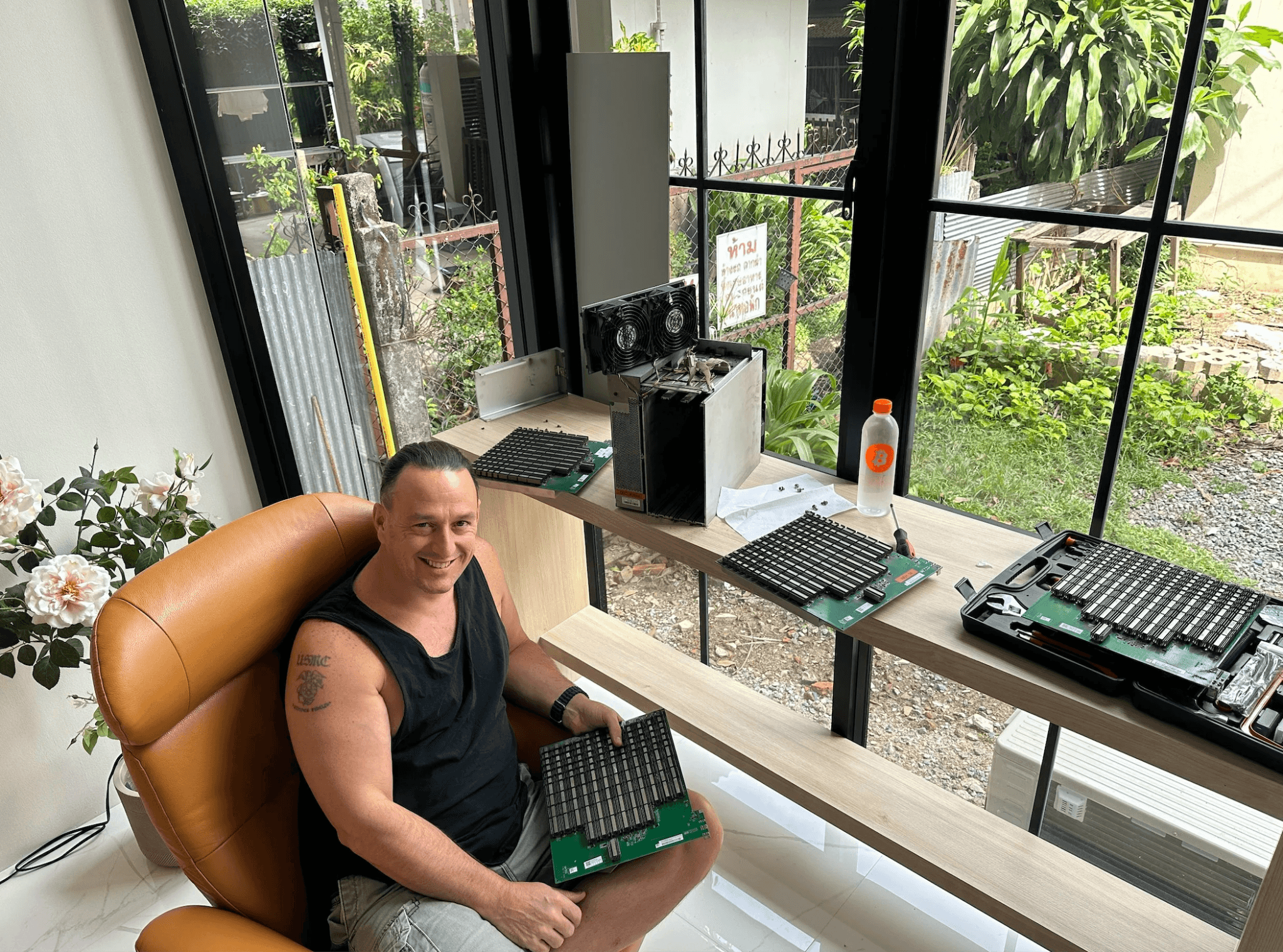
Kostro, by some of the windows in the Bitcoin Learning Center | Photo courtesy of Bitcoin Chiang Mai
The exterior of the building retains a more classic appeal. The overall feel of the space is one of elegance and effortlessness — it’s open, inviting, and uncluttered.
But, from what Kostro shared, the 40-year-old building, which was a gift to Fai and Kostro from Fai’s father, was in quite a different state when they took it over four years ago.
“It’s an old building, and when Fai’s father gave it to us, it had trees growing in it and the ceilings were only about six feet high,” explained Kostro. “It needed an overhaul.”
Kostro spent upwards of US$40,000 of proceeds from his business in the U.S. into it leading up to and within the first year of operations.
Despite the costs associated with rehabilitating and then running the facility Fai and Kostro have never charged those who frequent the centre a fee to do so.
“We don’t want to have a transactional relationship with our community members,” explained Kostro. “We just want to help them learn. We don’t even charge a fee for the Bitcoin ATM we have here.”
Since opening the facility, the Human Rights Foundation has provided the centre a grant to help cover a small chunk of the costs, but Fai and Kostro still cover the majority of the operating expenses and payroll, which can add up to approximately US$200,000 per year.
When I pressed Kostro on why he’d spend that much annually on the project, he replied with a simple, yet striking response: “We think that’s the best use of our bitcoin.”
How the Bitcoin Learning Center Operates
The Bitcoin Learning Center is the educational arm of Bitcoin Chiang Mai, which is a project that’s part of The Kostro Foundation, a non-profit that Kostro established to help disadvantaged youth.
According to the foundation’s website, the foundation started out by providing part-time English teachers to four children’s homes (i.e., orphanages) in Chiang Mai. One of these orphanages was the one to which Fai took Kostro soon after they first met.
Today, the foundation is more focused on Bitcoin-focused initiatives via Bitcoin Chiang Mai, many of which are run out of the centre.
The Team
Fai serves as the director of the centre, while the other six members of the team include a local operations manager, an international operations manager, an events and communications manager, a senior video editor and publishing lead, a head of creative media, and an AI infrastructure architect.
The team members earn competitive salaries, which is appropriate considering that they’re all bilingual and have graduated from college with honours.
Fai handpicks the staff members from the classes she teaches at International College, Chiang Mai Rajabhati University.
“I offer positions to the best of my fourth-year business school students,” said Fai.
If/when the students accepted, Fai and Kostro had them study Bitcoin via the Plan B Academy and Saylor University.
They tend to catch on quickly, according to Fai.
And catch on quickly they must, because there’s a lot happening at the Bitcoin Learning Center.
Programming and Media at the Bitcoin Learning Center
The Bitcoin Learning Center not only frequently hosts in-person events, but it produces content that receives upwards of 100,000 impressions per month.
In-person programming includes weekly Bitcoin meetups, Thai-language workshops and seminars for local audiences, and BitDevs sessions. The organization also hosts international events—often held in English—featuring prominent visiting Bitcoin figures.
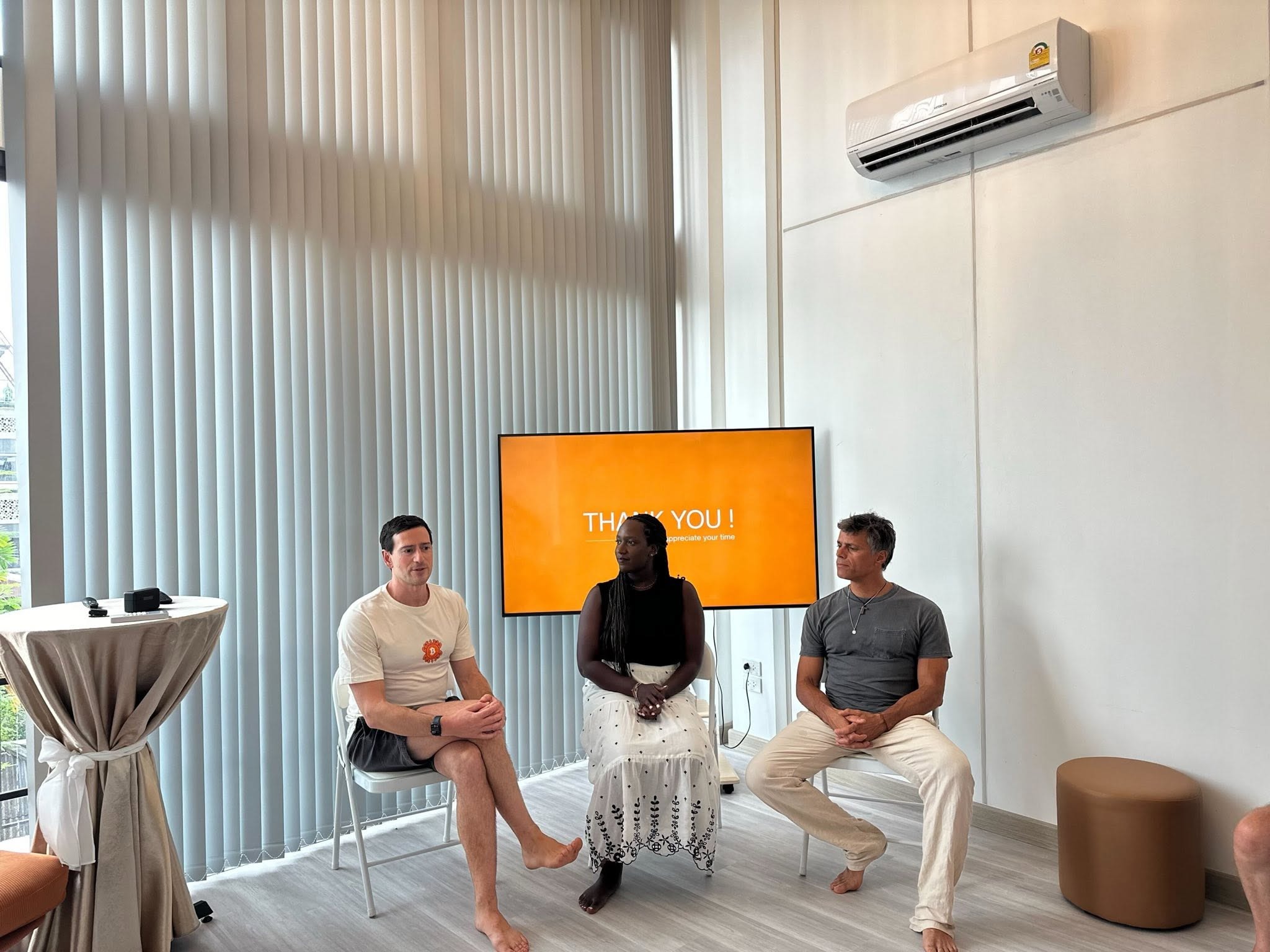
Human Right Foundation CSO Alex Gladstein, Fedi team member and Africa Bitcoin Institute co-founder Anaïse Kanimba, and Venezuelan opposition leader Leopoldo López speak at an international event at the Bitcoin Learning Center | Photo courtesy of the Bitcoin Chiang Mai
All of the events at the centre are exclusively in Thai or exclusively in English, never both.
“We don’t want to mix languages, because we don’t want people to feel embarrassed,” said Kostro.
The centre also serves as a place where Fai and Kostro can welcome distinguished visitors for more intimate discussions.
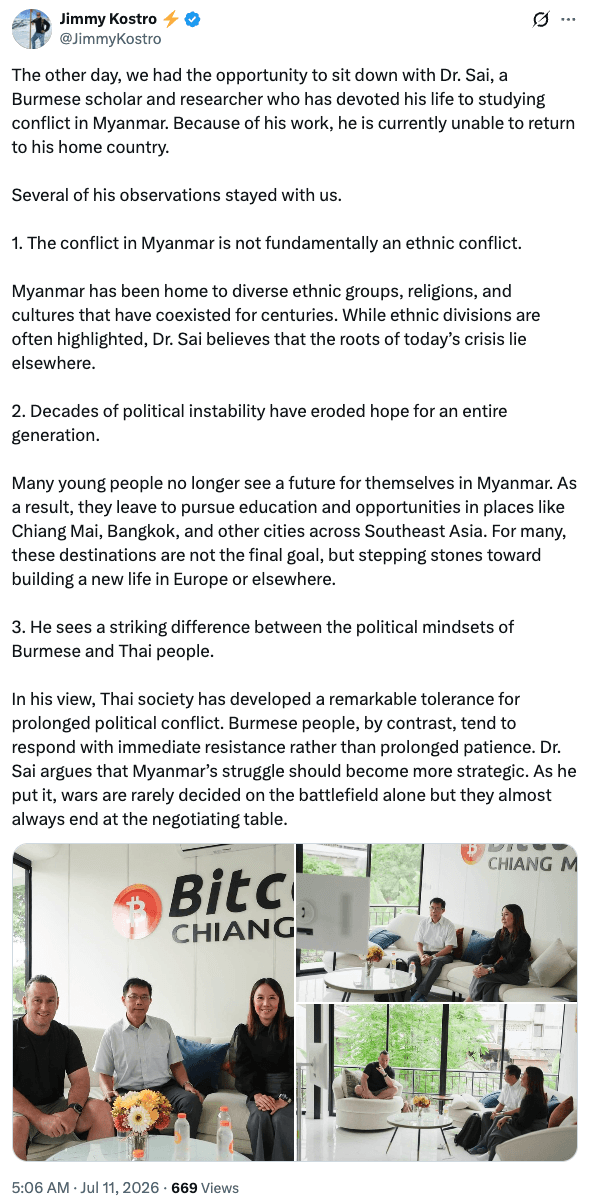
While the Bitcoin Learning Center reaches hundreds of people per month via in-person events, it reaches exponentially more through the media it produces, and much of that media is produced at the facility.
At the heart of the organisation’s media strategy is the Bitcoin Chiang Mai podcast, which Fai hosts.
While it now has over 10,000 subscribers on YouTube alone, it wasn’t even part of Fai and Kostro’s initial plan.
“One day, an attendee at one of the events said to Fai, ‘Listen, you guys are answering a lot of questions, and you have this equipment, these microphones and cameras — Why don't you start a podcast?’” said Kostro.
The idea resonated with Fai and Kostro. They got started on the project soon after.
They were aware of the success of the Right Shift podcast, the biggest Thai Bitcoin podcast in the country.
They respected the success that Righ Shift had had, but they didn’t exactly want to copy the same playbook.
Right Shift is based in Bangkok, the country’s capital city, and founder and CEO of the company, Piriya Sambandaraksa, has been a public Bitcoin personality since 2014.
Fedi Community Chat with Sambandaraksa, Southeast Asia Community Master Dea Rezkitha, and host Frank Corva
To differentiate themselves, Fai and Kostro decided to lean into the notion that they were based in Chiang Mai, which is based in a different region of the country, one that attracts expats and many from outside of Thailand.
While most of the content for the Bitcoin Chiang Mai podcast is predominantly in Thai, some is in English, as well. This attracts listeners from outside of Thailand.
“Our community is diverse and everyone is welcome and this is reflected in the podcast,” said Fai. “It attracts not only Thai people but people from other countries in Asia like our friends from Japan, Indonesia, and Malaysia.”
On the podcast, Fai often speaks with everyday Thai people, as opposed to major Bitcoin personalities. She has them share their Bitcoin stories — human and nuanced accounts of how they came to understand Bitcoin.
It was clear from the tone of her voice as she spoke about the podcast that it’s very close to her heart. Plus, hosting the podcast has allowed her students to see another side of her.
“Some of my graduate students text me like, ‘Hey, Professor Fai, you are super cool on your podcast,” said Fai, beaming. “When you are on the podcast it's another person, you’re a totally different person from when you teach in the classroom.”
Bitcoin Chiang Mai’s other media verticals include BitHealth, a doctor-led show focused on the parallels between Bitcoin and health; the Bitcoin Learning Center library, through which the team reviews books on Bitcoin and Austrian economics (e.g., Lyn Alden’s Broken Money and Henry Hazlitt’s Economics in One Lesson); Bitcoin Weekly News, a programme that breaks down the latest happenings in Bitcoin development, adoption, and policy; and Queen B, an effort geared towards women, focused on Bitcoin and financial literacy.
The latter vertical is new and something that Fai is quite excited about.
“Queen B is a programme designed to create a welcoming space for women to learn about Bitcoin and financial inclusion,” said Fai.
“Our audience is incredibly diverse — we have university students, entrepreneurs, mothers, retirees, business owners and we welcome everyone, even people who have never owned bitcoin,” she added.
“We want to empower women — not only Thai women, but women around the world — so the programming is going to be in English.”
Connecting the Bitcoin Learning Center with Universities
When Fai and Kostro started the Bitcoin Learning Center in 2022, they aimed to fill the educational gap around Bitcoin — to teach what universities weren’t quite ready for Fai to teach at the time.
Four years later, universities in Chiang Mai have warmed up to the idea of Bitcoin in large part thanks to the work that the Bitcoin Learning Center team has done.
And Fai couldn’t be more proud that two Bitcoin Learning Center team members, Eve and Neo (whom she refers to as “Bitcoin leaders in Chiang Mai”), now speak about Bitcoin regularly at universities.
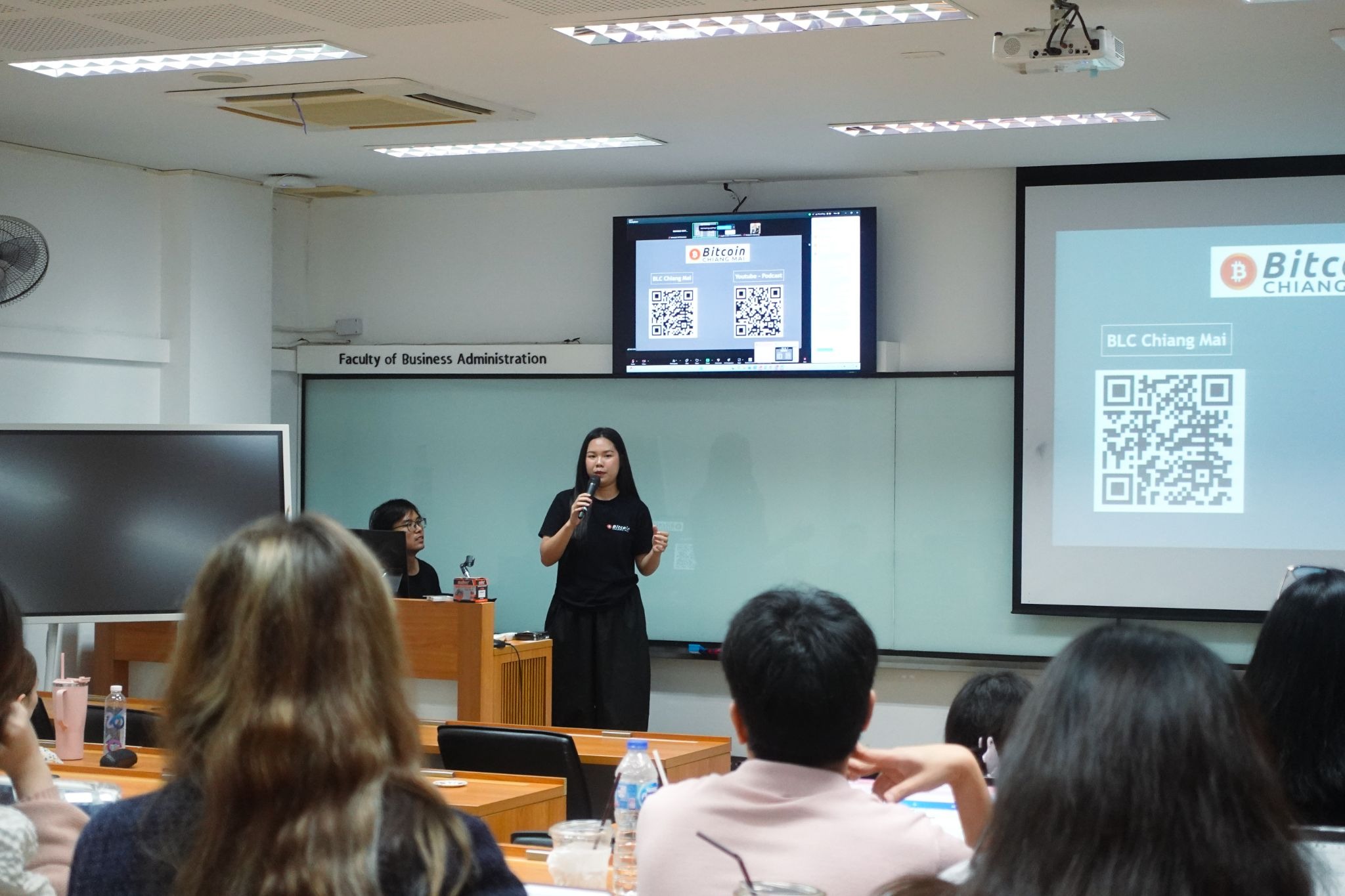
Eve, speaking to business students at Chiang Mai University | Photo courtesy of Bitcoin Chiang Mai
“I'm so proud to see these two graduate students teach Bitcoin and financial literacy in the university,” said Fai. “They speak at conferences at the university about Bitcoin because of their proof of work.”
Kostro added that the Bitcoin Learning Center more frequently works with Chiang Mai University and Chiang Mai Rajabhat University in part because Fai’s colleagues have noticed the impact that the Bitcoin Learning Center has had on the university’s recent graduates who work at the centre.
“Because we’ve employed these students and because Fai’s colleagues see the goodwill of the Bitcoin Learning Center, we’ve begun working with the university on a regular basis and now have an open-door policy with it,” explained Kostro.
“Fai just told me the other day she scheduled a seminar for us to teach at the university in September,” he added.
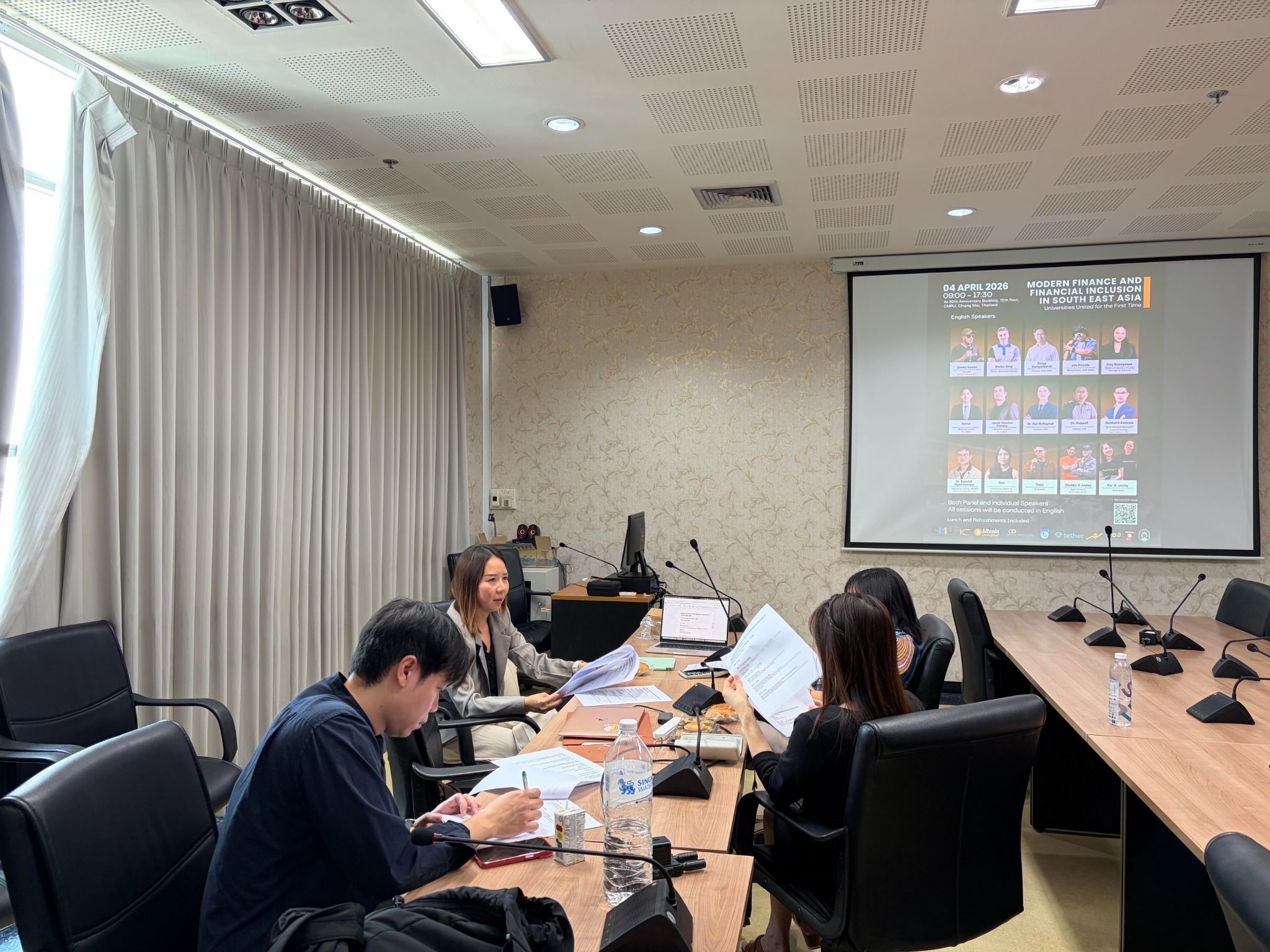
Fai and members of the Bitcoin Learning Center team at a “modern finance” seminar at Chiang Mai Rajabhat University | Photo courtesy of Bitcoin Chiang Mai
“Opportunities like this have come from our proof of work — our consistent, applied effort.”
More on the work that the Bitcoin Learning Center team does outside of the walls of the centre in Part III.
