
July 9, 2026
Organisation Spotlight: The Bitcoin Learning Center in Chiang Mai, Thailand — Part I of III
“What’s the ROI on the Bitcoin Learning Center? Well, we’re reaching 2,000-3,000 per day with our content, and we have hundreds of people coming through our building on a regular basis. The ROI is that we sleep really well at night knowing that we’re trying to help people learn. If Bitcoin’s going to do what we all think it’s going to do, what could be a better use of our time?”
The quote above is from Jimmy Kostro, co-founder of the Bitcoin Learning Center, located in Chiang Mai, Thailand.
Kostro created the facility in 2022 alongside Napatsanun Chatchayaladasiri, who goes by Fai, in an effort to help underserved communities adopt and benefit from Bitcoin.
In just under four short years, they’ve made the Bitcoin Learning Center the largest physical Bitcoin hub in Southeast Asia, and the centre is part of a larger umbrella organisation called Bitcoin Chiang Mai, which advances Bitcoin as a tool for financial empowerment through a variety of initiatives.
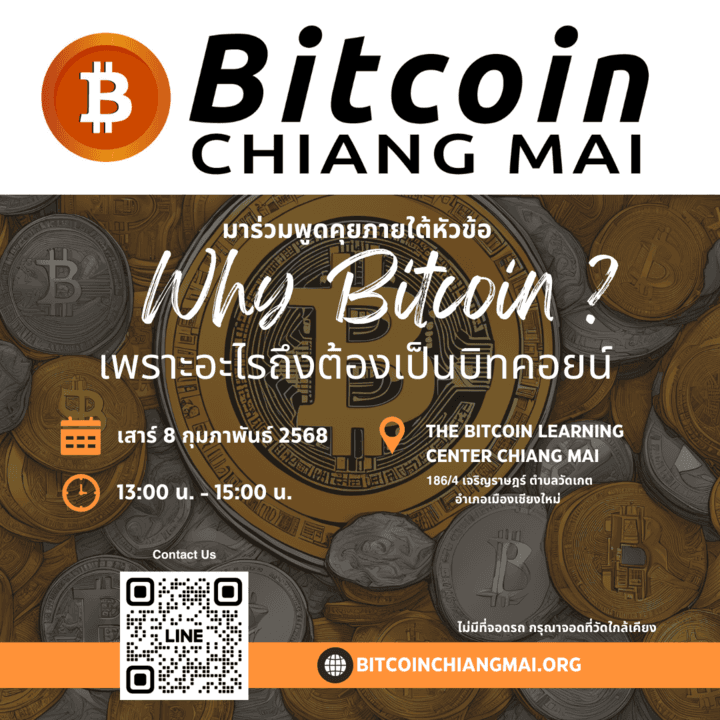
Promotion for an introduction to Bitcoin class at the Bitcoin Learning Center
From partnering with universities to maximising their reach via multiple media verticals to engaging with local government officials, Kostro and Fai have become a leading force for Bitcoin adoption in the region. They acknowledge that both bottom-up and top-down approaches are necessary if Bitcoin is to be widely adopted in Southeast Asia, and they’re making every effort to advance Bitcoin on both fronts.
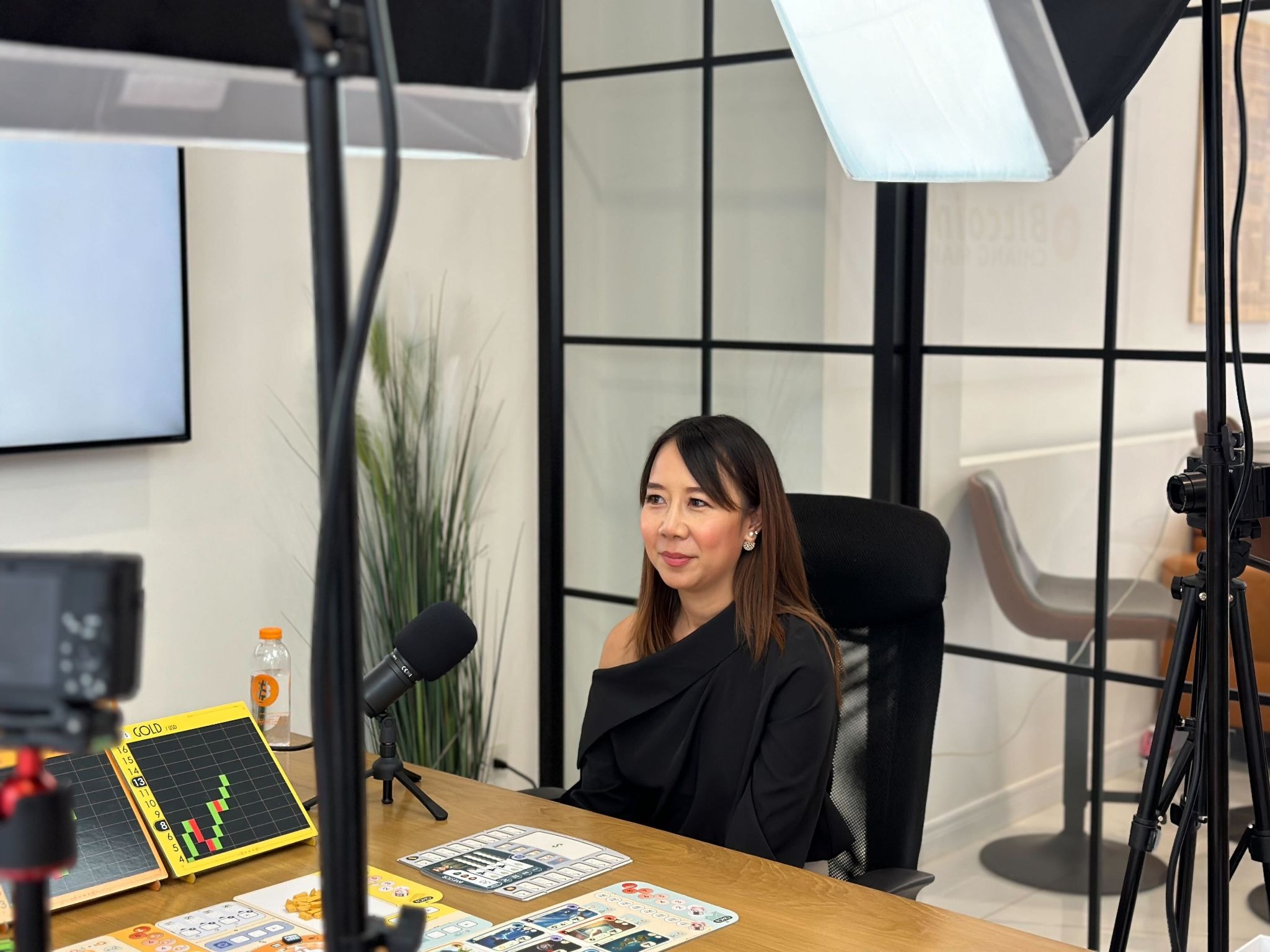
Fai, recording the Bitcoin Chiang Mai podcast | Photo courtesy of Bitcoin Chiang Mai
Oh, and did I mention that they’re doing this predominantly on their own dime?
That’s right.
To get the Bitcoin Learning Center and Bitcoin Chiang Mai off the ground, they largely tapped into their own funds. (They've more recently received support from sponsors.) They did this simply because they believe that these projects provide the type of support and resources that the region needs for Bitcoin to thrive.
“We deduct a certain amount of money from what we earn to give to the Bitcoin Learning Center,” Fai told me in an interview.
“Some people donate to a church and others to a university, but we donate to the Bitcoin Learning Center,” she added.
“We believe this is going to be a great foundation for the future of the Thai people.”
I’ll dive into the details of what this foundation is composed of in the second and third parts of this series.
In this first part, I’d like to tell the story of how Kostro, an American from northern New Jersey, and Fai, a Chiang Mai native, first met and decided to begin working together.
How Kostro Met Fai
In 2013, after completing a stint in the U.S. Marine Corps and working for a short while at a same day logistics firm, Kostro founded a meal-delivery logistics company comparable to DoorDash and Uber Eats.
Based in Miami at the time, he helped the company scale within the city as well as in other major U.S. cities, including New York, Philadelphia, and Washington, D.C..
By 2017, the same year he discovered Bitcoin (and crypto), he’d hired someone to manage the company’s operations full time.
A year later, Kostro decided to take off to see the world. He visited 40 countries over the course of four years before deciding to return to Thailand indefinitely, for a number of reasons, including one related to Bitcoin.
“I got involved in the whole ICO thing just for number go up, but then I had this revelation — I realised Bitcoin was the real breakthrough invention,” Kostro told me in an interview.
“Then, I said to myself, ‘Wait a minute, if I’m traveling and I have someone running my company, I should really look into living remotely where there's that geoarbitrage, and I can stack 300% more sats due to the lower cost of living,” he added.
“And all roads led to Thailand — I moved four and a half years ago.”
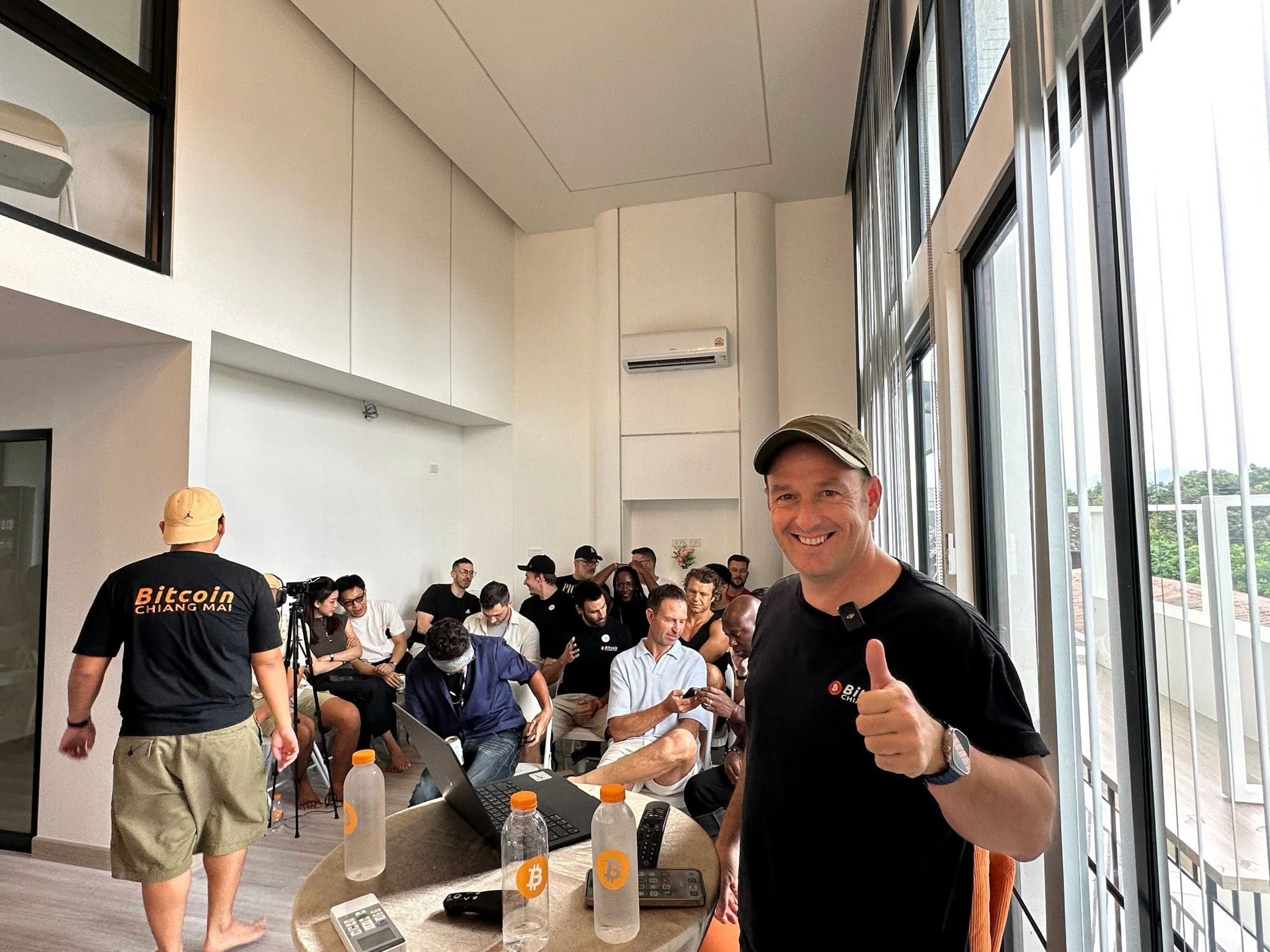
Kostro, at an event with international guests, including Fedi CEO Obi Nwosu and Jeff Booth, the author of The Price of Tomorrow | Photo courtesy of Bitcoin Chiang Mai
Kostro added that there were also factors beyond affordability that lured him back to Thailand.
He said that it’s a mix of the safety (“it’s the safest country I’ve ever been to”), the culture (“the people are kind, gentle, polite, and respectful — I've misplaced everything from phones to iPads to watches to passports to money, and it's all came back to me”), the food (“it’s just incredible”), and the weather (“it’s just like south Florida”) that also won him over.
All in all, he couldn’t speak highly enough of the Southeast Asian nation.
Fai, who was born and raised in Chiang Mai, moved to New Jersey at age 20 as part of an exchange program. (Fai and Kostro’s paths didn’t cross in New Jersey, as she studied in the southern part of the state.)
Years later, Fai returned to the United States to work as a journalist in Los Angeles for a year before heading to Dallas to go to business school.
After completing her MBA, she returned to Thailand to start her own business, Go Abroad by Fai Co., Ltd., an education consulting firm that helped students to study in the UK, Canada, Australia, Europe, and the United States.
She also became a part-time lecturer at Chiang Mai University (2013-2016) as well as International College, Chiang Mai Rajabhat University (2013-present) where she teaches international business and investment to this day.
When COVID struck in 2020, though, “international education came to a standstill,” as Fai put it, and she had to close her business.
Being a skillful entrepreneur, Fai pivoted to where she saw a need — she started a healthy meal delivery business, Tawang Delivery, while most in Thailand were homebound.

An image of Tawang Delivery’s healthy meals | Photo courtesy of Fai
It was this endeavor that would inevitably lead her to Kostro.
“Jimmy was one of my customers,” said Fai. “That was the beginning of our journey together.”
While it took a moment for Kostro and Fai to calibrate with each other, it wasn’t long before the two entrepreneurs with experience in the food delivery business began cooking together.
Kostro and Fai Start to Cook
“What are you doing with your life?”
This is one of the first questions Kostro remembers Fai asking him.
He recounts this with a hearty laugh while Fai smiles — without refuting that she’d made this inquiry early on.
“She pretty much just called me straight out,” said Kostro, still laughing.
After asking this question, Fai then articulated to Kostro that it seemed as though he was “missing something.”
She proceeded to ask him to join her on a trip to a girls’ orphanage that she supported through COVID.
Kostro happily accepted the invitation.
The experience at the orphanage moved Kostro deeply.
“I want to get involved. How can I help? What do we do next?” Kostro asked Fai.
The two began to brainstorm answers to these questions. (They’d eventually begin fundraising for the orphanage, but more on that in the next part of the story.)

Fai (back left) and Jimmy Kostro (back right) at a girls’ orphanage in Chiang Mai, Thailand. | Photo courtesy of Bitcoin Chiang Mai
While doing so, Kostro said to Fai, “Okay, you took me somewhere; now I want to take you somewhere.”
The destination Kostro had in mind was slightly different from the one to which Fai had taken him — it was a Bitcoin meetup.
“One of the reasons I moved to Chiang Mai is because they had one of the longest-running Bitcoin meetups in Asia,” said Kostro. “It’s been going for 10 years now.”
According to Fai, Kostro billed the outing as something slightly different. He was going to take her to a place where intelligent people gathered to talk about money.
“He wanted to take me to a place where all the smart people go, and I was just like ‘Okay, I'll go because I want to learn,’” said Fai.
To Fai’s dismay, her first impression of the event was more concerning than inspiring.
“The restaurant was crowded and full of people smoking, drinking beer, and talking a lot,” said Fai. “At first glance, I was like, ‘Really. Are these the smart people?!”
In the midst of the less-than-academic atmosphere, Kostro introduced Fai to a friend of his, Stefan King.
King runs the weekly bitcoin meetup and authored the book Blockchain Startups, published in January 2021, and he captured Fai’s attention almost as quickly as he lost it.
She was pleased to meet a colleague but was thrown off by one of the first questions he asked her: “Do you want to learn about Bitcoin?”
Being asked this question was like hearing nails on a chalkboard for Fai.
“Everything Stefan told me about Bitcoin that night went against the theory I teach at the university, so I couldn’t help but think Bitcoin was a scam at first,” said Fai.
Still, she didn’t bow out of the conversation. While she had her deep-seated doubts about Bitcoin, she still listened as King described Bitcoin to her as a “completely different way of understanding money and economics,” as she put it.
“The mainstream theory we teach at the university is Keynesian, but I learned that night that the theory around Bitcoin is the opposite of that,” said Fai. “So, I had to start studying again.”
While continuing to learn about Bitcoin, Fai invited both King and Kostro to give a guest lecture on Bitcoin to one of her classes, which was full of international students from countries like China, Myanmar, and Bhutan — countries in which people “have varying degrees of limitations on individual freedom,” as Fai put it.
Fai, Kostro, and King would also go on to give guest talks at other universities in Chiang Mai in the following years.
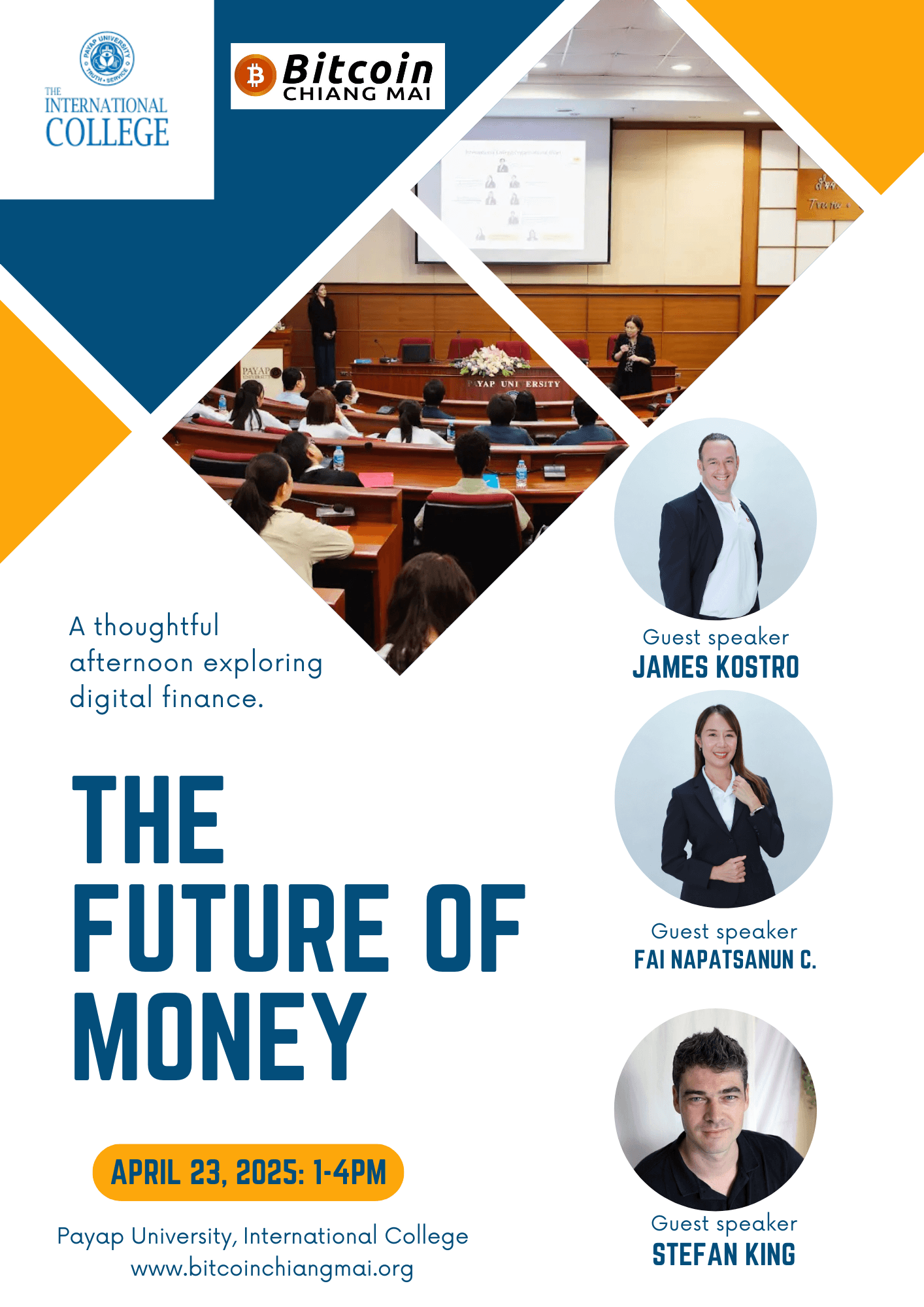
A promotional image for an event at a university in Chiang Mai at which Kostro, Fai, and King were guest speakers
“Once my students started learning about Bitcoin, they just wanted to learn more,” said Fai. “That was the beginning of my idea to teach them financial literacy. But I didn’t just want to teach them how to invest in bonds and to save money in a bank account — I wanted to teach them how to save with freedom money.”
While Fai’s intentions were strong, the universities at which Fai lectures weren’t quite ready to permit her to teach Bitcoin at that time.
She needed another place to do such work, somewhere outside of the traditional educational environment.
And so the Bitcoin Learning Center was born…
More on how the centre was created and what it facilitates in Part II.
