April 15, 2026
Community Spotlight: Bitcoin Ekasi
“If Bitcoin fully succeeds one day and does what we think it's going to do, then this is definitely going to be one of the most impactful technologies in the world.”
This is what Hermann Vivier, founder and Chairman of Bitcoin Ekasi, a Bitcoin circular economy based in a township in Mossel Bay, South Africa, told me about the Fedimint protocol, which underpins Fedi wallets.
I guess you could say he’s quite excited about the technology — to put it mildly.
He and members of other South African Bitcoin circular economies have been running a self-hosted test federation since mid-2025 and are about to migrate to a self-hosted permanent federation.
Vivier, a long-time Bitcoiner, has engaged with more than his fair share of Bitcoin technology over his years in the space, but Fedimint strikes a certain chord with him, largely because it solves a key problem for some of members of the Bitcoin Ekasi community.
“Certain people in the community are just never going to take self-custody,” said Vivier.
While Vivier believes that certain custodial options play an important role for the time being, he doesn’t see them as long-term solutions.
In his mind, this is where Fedimint and Fedi come in.
“With Fedimint and Fedi, you can take community custody of funds,” said Vivier.
“It’s the best of both worlds,” he added, referring to Fedimint technology being semi-custodial, yet decentralised.
For this reason, Vivier believes that “Fedimint is one of the most interesting and impactful things I've ever come across in Bitcoin.”
And not only is he impressed with the technology, but its founder also recently left quite an impression on him.
Eric Sirion Visits Bitcoin Ekasi
Eric Sirion, founder of both the Fedimint protocol and co-founder of Fedi, recently spent six weeks working on the ground with the Bitcoin Ekasi community.
When I asked Vivier about what it was like having him there, he couldn’t say enough good about Sirion, who he described as someone who is perhaps even more humble than he is technically gifted.
“The way he showed up here, you would think he’s just a regular everyday guy — not the co-founder of one of the potentially one of the most impactful technologies in the world,” recounted Vivier. “The humility he had while interacting with the team was just incredible. There’s this sort of celebrity culture amongst some people in Bitcoin, but Eric doesn’t have that — he’s totally grounded.”
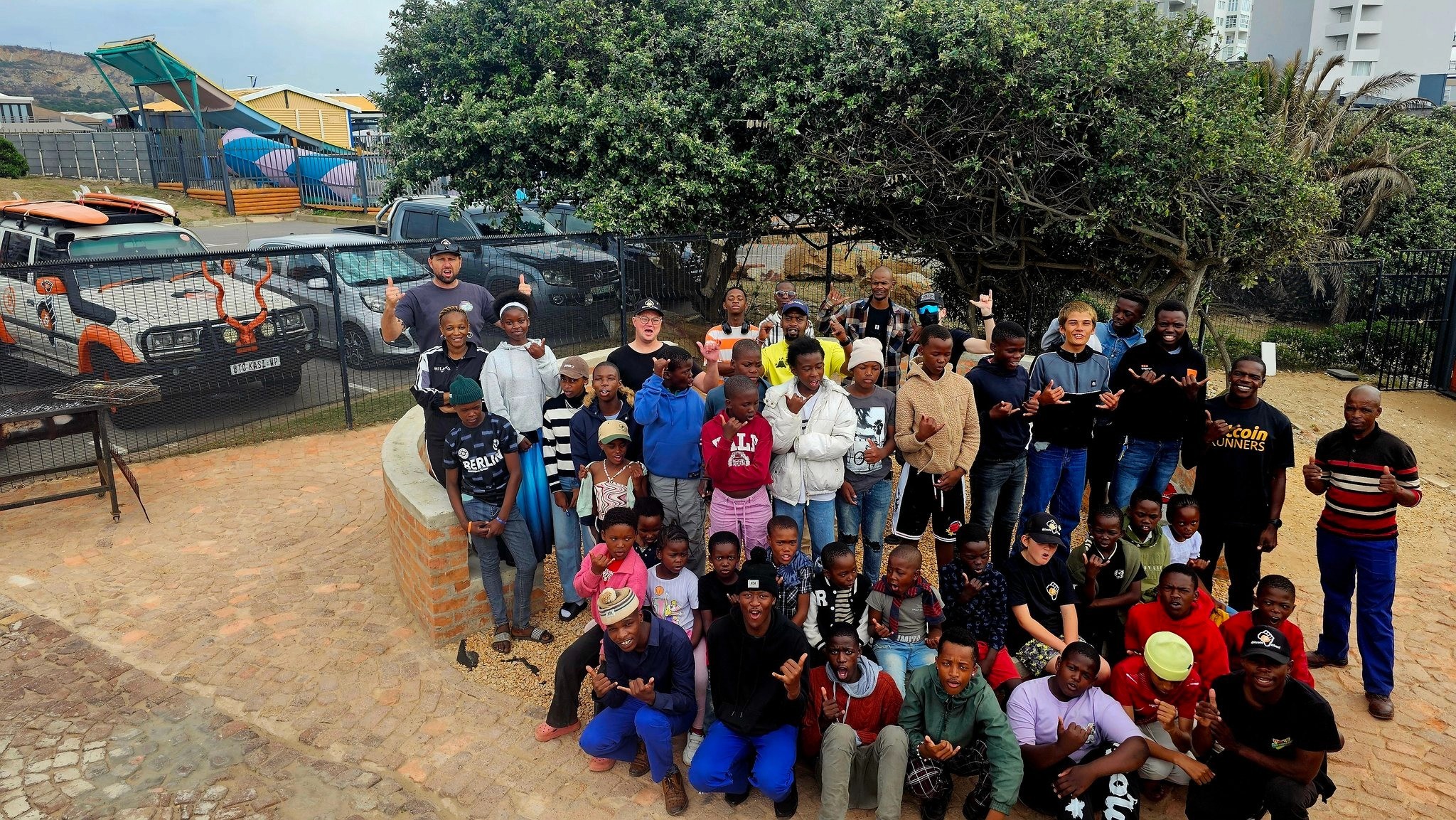
Eric Sirion with members of the Bitcoin Ekasi community | Photo from Bitcoin Ekasi’s X account
While in Mossel Bay, Sirion helped the Bitcoin Ekasi team do everything from vibe code attendance software for The Surfer Kids program (a non-profit tied to the Bitcoin Ekasi project that empowers underprivileged youth from the area) to building an NFC reader for arcade machines so that the kids from the area could pay to play games with their Bitcoin Bolt Cards.
A members of the Bitcoin Ekasi community pays to use an arcade machine with a Bolt Card
To the former point, Vivier said that Sirion instilled a deep sense of “you can just build things” in the community members he mentored while on the ground.
“Because of the work that Eric did with the community members he worked with, they discovered that there’s a whole bunch of stuff we can just build ourselves to solve some of our own unique problems,” explained Vivier.
Using the attendance software as an example, Vivier explained the team had tried using apps they’d downloaded and even built their own spreadsheet in Excel but that they’d never quite found the right solution.
“Eric had this attitude of ‘You can just build what you need,’” said Vivier. “He made us realise what we needed and then not only showed us how to build it but stayed long enough to get us into the rhythm of solving certain problems with AI or vibecoding.”
Vivier brought up the point about the NFC reader, in part to illustrate Sirion’s prowess (he got the NFC reader to work with the arcade machine) and in part to make the point that Bitcoin is on the verge of integrating itself into much of the everyday technology we interact with.
In fact, he thinks that incentivizing people to use bitcoin for something as simple as paying to play a video game is what the next phase of Bitcoin adoption looks like.
“We’ve been trying to teach people about Bitcoin through the lens of monetary policy and blah, blah, blah, but I'm beginning to think that we passed the point where we onboard people that way,” said Vivier. “I think we're going to start getting to a point where you're going to have to demonstrate something real — like how to buy something from a shop with bitcoin — to onboard them.”
For this reason and others, he’s quite bullish on Fedi’s new project SateNet.
SateNet in Mossel Bay
SateNet is a new project that the Fedi team is working on that will facilitate internet access to communities that either do not have access or that have low-quality expensive versions of it.
With SateNet, communities gain access to satellite internet via a physical structure/antenna installed in their community that they can pay for in sats via the Fedi app.
The Fedi team is currently looking to launch this project in four different locations globally, with Mossel Bay, in the heart of the Bitcoin Ekasi community as one of them.
“With SateNet, you’re creating a great service that people want and you’re incentivizing them to pay for it with sats rather than fiat,” said Vivier.
To expand on Vivier’s point, SateNet users will have the option of paying in either fiat or bitcoin when they purchase internet service via SateNet. Importantly, though, there will be a steep discount when they pay in bitcoin, enabling users to not only obtain internet service at a better price but to save more of their hard-earned sats.
“There’s a very strong incentive for people to say, ‘Maybe I should try bitcoin as a payment option because I can pay about half the price for internet when I use bitcoin to pay for it,’” said Vivier. “That's the way you incentivise people to start using this. The next phase of adoption is how do you incentivise people to use this rather than try to orange pill people.”
SateNet is now up and running within the Bitcoin Ekasi community, and community members are taking advantage of it.
“I’ve tested it once myself, and it worked beautifully,” said Vivier, seemingly surprised that the service is up and running smoothly since he remembers when it was just a concept mere months ago.
“We basically just provided a little bit of soil for Modibe (Fedi’s Africa Community Master) to come in and make it happen,” said Vivier. “And he did, and it’s amazing.”
Bitcoin Ekasi has deployed four SateNet hotspots in the community where community members can go to utilise the service. For each of these locations Vivier and the Bitcoin Ekasi team would like to build a physical space for people to sit and utilise this new internet service to its maximum potential.
“We want to create a place where people can come and sit on a couch and work, sort of like an internet cafe,” said Vivier.
Using Fedi for Communication + Payments
Beyond using the Fedi wallet for community custody and the SateNet Fedi Mini App, the Bitcoin Ekasi team also utilises Fedi’s Community feature to organise events.
Messaging about events like ‘Movie Night,’ an event at which the community gets together to watch short films or videos on Bitcoin, or My First Bitcoin Diploma graduations often happen within the Community section of the Fedi app.
Plus, at these events, the Bitcoin Ekasi team uses the Fedi wallet to distribute sats.
For example, on 9 April, the first 30 people to attend Movie Night received 2,500 sats each in the Fedi wallet.
“Movie night is a great way to bring communicating and making payments within the same app together,” said Vivier.
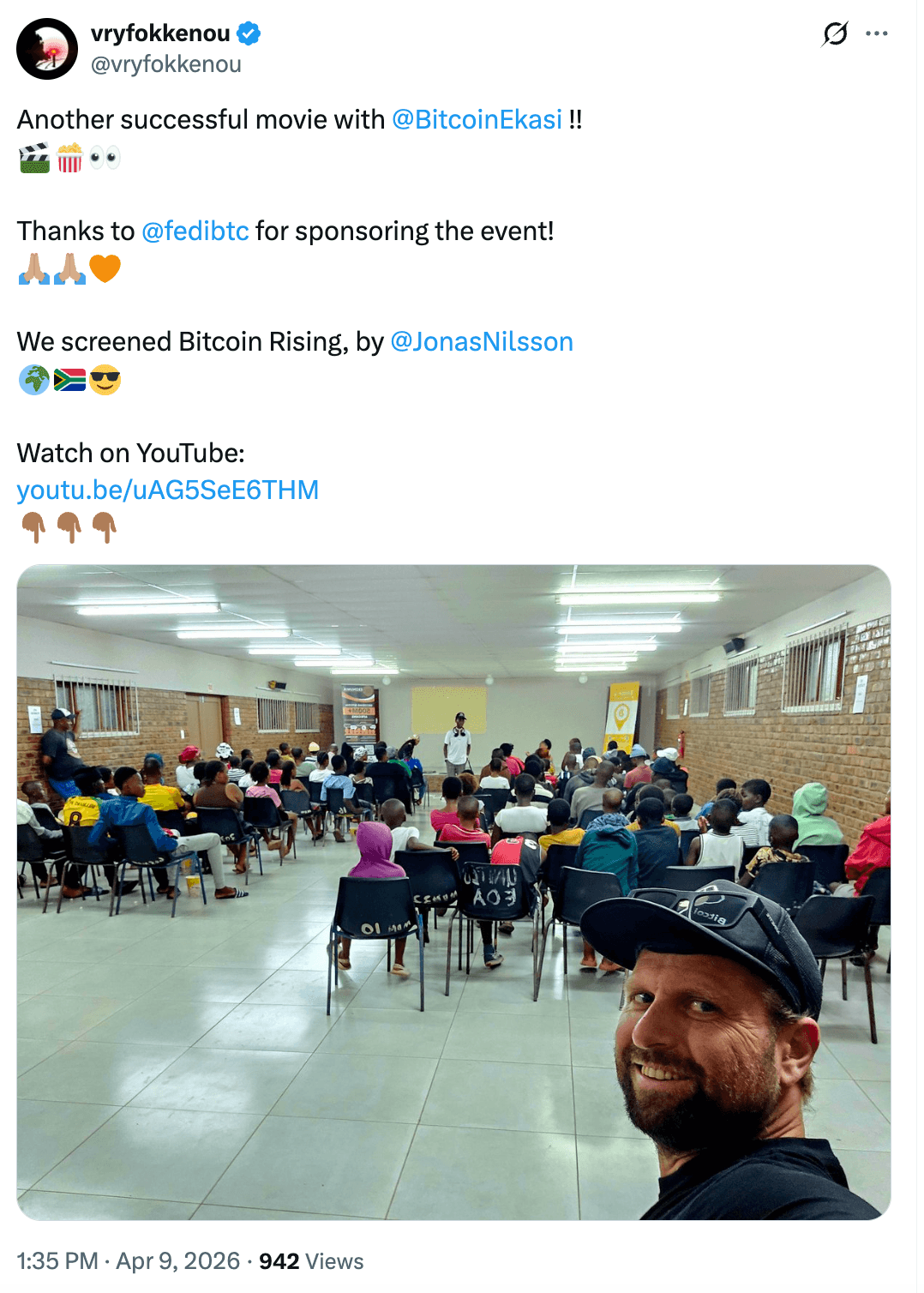
Vivier posts from his personal X account about Bitcoin Ekasi’s Movie Night
And on the topic of distributing those sats via the Fedi wallet, Vivier once again reiterated how much of a proponent he is of Fedimint technology.
“It's the community custody aspect of Fedi that I am most excited about, personally,” he said. “I’m really excited about taking the adoption of the Fedi app to the next level.”
