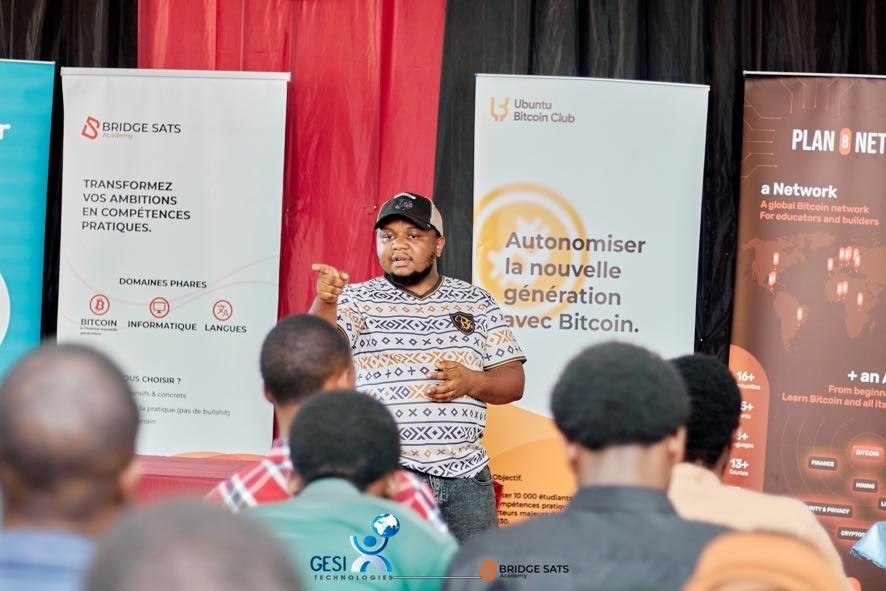
May 27, 2026
Builder Spotlight: Gloire Kambale Wanzavalere of the Democratic Republic of the Congo (DRC)
Bitcoin has a tendency to attract entrepreneurial polymaths.
I’ve interviewed a number of these types over the years, and I’m often taken aback at just how dynamic some are.
With that said, I’ve only come across a few that are as versatile and innovative as Gloire Kambale Wanzavalere, founder of Bridge Sats and Kiveclair, co-founder of the Africa Bitcoin Conference, and wearer of many other hats.
To call Gloire (pronounced glo-wáhr) a renaissance man is to perhaps understate his abilities.
Through Bridge Sats and his various other endeavors, Wanzavalere is involved with everything from facilitating OTC bitcoin trades to helping people and companies access enterprise-grade internet to educating university students about Bitcoin to running a wine business.
Many of these efforts are focused on his home country, the Democratic Republic of the Congo (DRC), but some involve other African countries, as well.
Self-taught in programming, he contributes to the initial development for each of the projects he’s involved in, before stepping back and serving as a product manager.
Amidst all of the projects he’s working on, he’s also found the time to set up a Bridge Sats federation through Fedi, a platform that he believes will eventually be “the gathering point for the local community to pay and navigate the Bitcoin application ecosystem in Congo.”
So, what is it that motivates Wanzavalere?
According to him, it’s mainly two things.
One, he wants to see his home country, as well as Africa more broadly, develop economically.
He has an ambitious vision, which he describes as “utopian,” in which he helps rally energy producers, Bitcoin miners, investors, and entrepreneurs around a common mission of development in Africa.
Other than that, he just doesn’t like to be bored.
“My tendency to get bored quickly leads me to work on multiple fronts,” Wanzavalere told me in an interview.
Luckily for his countrypeople, for Africa, and for Bitcoiners around the world, it doesn’t seem that there’s any risk of this happening any time soon.
Before we take a closer look at what keeps Wanzavalere busy, let’s trace his journey to becoming one of the most impactful Bitcoiners in Africa.
Wanzavalere’s Early Life
Wanzavalere was born and raised in the DRC.
From childhood, he was an autodidact with an interest in computers.
“I grew up with a computer in my hands from the age of five or seven, which was a rare privilege at the time,” said Wanzavalere.
He describes his academic path as “relatively short,” as he only attended college for two years after obtaining a high school diploma in math and physics.
In 2018, he dropped out of a law programme at the University of Goma to pursue his newfound passion — Bitcoin.
“I told my parents that day that I had discovered something I was so passionate about that finishing my degree no longer felt essential, especially since it would take up too much of my time,” said Wanzavalere.
He understood full well the risk of leaving behind the prospect of obtaining a university degree, but he let the anxiety that came with the lack of security serve as fuel.
“It was a major risk, but that’s precisely what pushed me to commit so deeply to Bitcoin,” said Wanzavalere. “I knew that without a degree, my professional future would depend entirely on how well I understood it.”
Discovering and Getting Involved with Bitcoin
It wasn’t quite on a whim that Wanzavalere committed to Bitcoin.
He’d first heard about it in 2014, though he dismissed it at the time.
He came across it again in 2018 as a victim of a cloud mining scam. But this experience didn't have the effect on Wanzavalere that it's had on so many others.
Instead of cursing Bitcoin and turning his back on it, he began to research it more deeply.
“I decided to stop everything to study the subject with the seriousness it deserved,” said Wanzavalere.
His studies led him to educational videos from French-speaking Bitcoiners such as Jacques Favier, Pierre Noizat, Mael Rolland, and Yorick de Mombynes amongst others. The Bitcoin.fr channel also became a major resource for him and the book Bitcoin, La Monnaie Acéphale (translation: Bitcoin, the Headless Currency) played a “decisive role in [his] journey.”
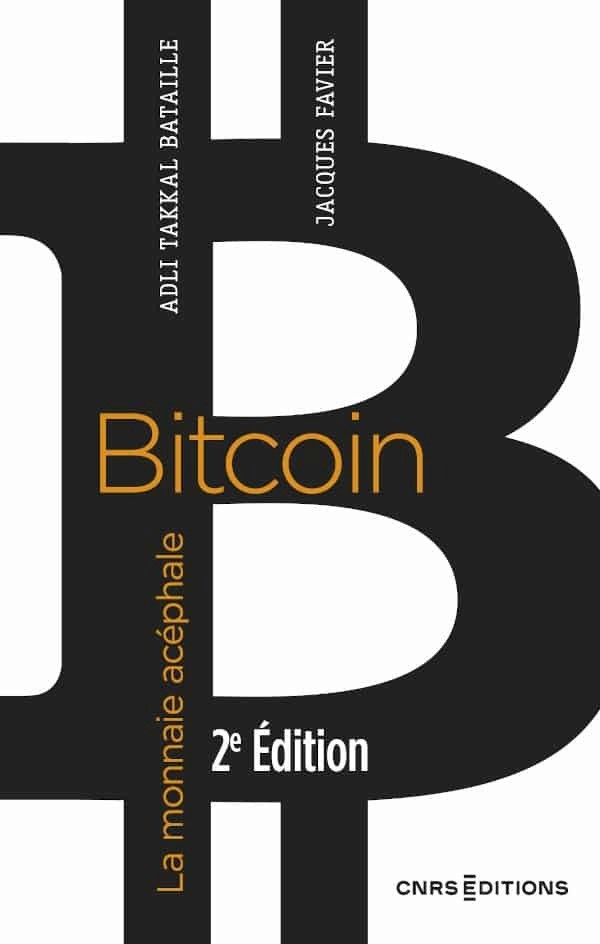
The cover of one of Wanzavalere’s favorite books, Bitcoin, La Monnaie Acéphale
Through months of research, Wanzavalere set an educational foundation for himself. Motivated to put that education to work, he moved to a place where he could more easily work online.
“I decided to quit everything and move to another city to benefit from a better internet connection,” said Wanzavalere.
He left Goma, where he’d been studying and living, and moved just across the border to Gisenyi, Rwanda.
By 2019, he landed a job in the broader crypto industry through which he was paid in ETH. It didn’t take him long to realise that this was not the way.
“By 2020, I realised that only Bitcoin made sense,” said Wanzavalere.
Early in 2020, Wanzavalere launched an online media platform focused on Bitcoin, through which he published articles on topics like how Bitcoin makes money transfers in Africa easier.
At the end of 2020, Wanzavalere began working for a French media outlet, Cointribune, where he covered Bitcoin adoption in Africa, and he later joined another media outlet through which he shared analysis on Bitcoin.
In May 2021, a massive volcanic eruption shook Goma. Wanzavalere saw this as an opportunity to use Bitcoin to help those affected.
In September 2021, he founded Kiveclair, an educational organization that works to empower people with Bitcoin and other open-source technologies, and raised US$20,000 worth of bitcoin for the victims of the eruption.
In taking part in this effort, Wanzavalere learned an important lesson about what bitcoin was and wasn’t good at the time.
“While the fundraising was a success, the use of Bitcoin was not, as those populations didn't actually need it,” he explained. “A conversion to cash would have made their lives easier. I then began working on a thesis regarding the best way to stimulate healthy adoption in Africa.”
Not only did this fundraising effort teach him a lesson, but he was becoming more frustrated with what was passing as a “Bitcoin revolution” in Africa.
“I felt a growing unease regarding the direction Bitcoin adoption was taking in Africa,” said Wanzavalere. “I saw more and more people distributing sats to children, taking photos of them during a payment in a shop, and calling it a ‘Bitcoin revolution.’”
At this point, he began to reflect on what was truly necessary to foster a better economic reality for Africa.
Developing a Broader Bitcoin Vision
He came to the realisation that the “African challenge is not just monetary," and that energy and infrastructure are necessary to facilitate wealth creation in Africa.
“The West benefits from a complete economic ecosystem thanks to abundant energy, industrial production, efficient logistics, and developed payment networks, whereas in Africa, these foundations still needed to be invented,” said Wanzavalere. “The lack of energy limits local production, which reduces trade and discourages investment in road infrastructure, locking the continent in a cycle of structural underdevelopment.”
By late 2022, Wanzavalere came to believe that Bitcoin mining could incentivise energy production.
He had a model for what this could look like just 35 kilometers north of him in Virunga National Park, where Sébastian Gouspillou and the team at BigBlock Datacenter were mining Bitcoin with hydroelectric power. (Gouspillou has supported Wanzavalere’s efforts in many ways, though the two don’t have an official business relationship.)
Gridless was founded that same year and became an even better model for this concept, as its Bitcoin mining efforts in rural Kenya, Malawi, and Zambia are incentivising the electrification of the rural regions of these countries.
“This energy can then power productive projects led by local entrepreneurs who now have the possibility to sell their products freely thanks to this global payment network,” said Wanzavalere. “The need to transport these goods would naturally create a demand for local logistics infrastructure, thus completing the economic loop.”
All of these inspirations fed Wanzavalere's aforementioned "utopian" vision, in which more energy creation kickstarts a virtuous cycle. And so, in 2023, he formed the organisation to help bring this vision to life.
“I had to lay the first stone of this vision, and I called that stone Bridge Sats,” said Wanzavalere.
Bridge Sats
With some financial help from a friend who served as a VC investor, Wanzavalere founded Bridge Sats.
He aimed for it to be a multidimensional enterprise from the onset.
“From the beginning, it was clear that we would launch many activities,” explained Wanzavalere. “I always take the time to immerse myself in each project to lay the foundations before gradually letting the team integrate and lead the rest.”
That team is now composed of 12 full-time members as well as four part-time contractors, and they work together on seven projects.
Below is an overview of said projects:
SatGlob: This project provides enterprise-grade satellite connection to 24 different African countries and offers a leasing programme so that institutions don’t have to incur a heavy initial hardware investment. SatGlob has initiated discussions with SateNet to allow Bitcoin payments and deploy satellite backhauls to underserved communities.
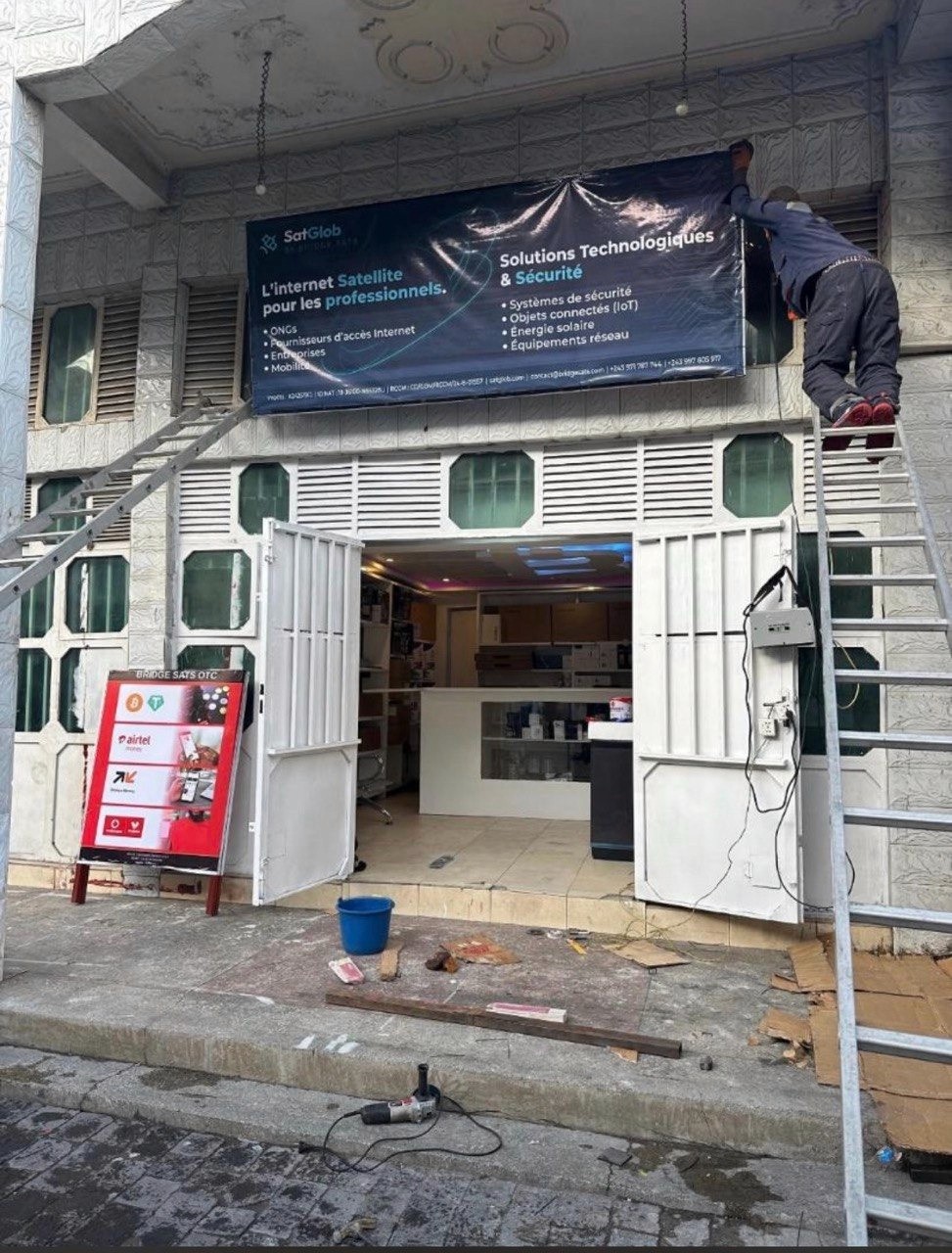
A worker hangs a SatGlob sign. | Photo courtesy of Bridge Sats
Eclaircash: This is an app that uses the Lightning Network for remittances in a dozen African countries. A B2B version of the app is in production.
Bridge Sats OTC: Through this service, Bridge Sats buys and sells bitcoin and USDT. It operates in five African countries, accepts payments over Airtel Money, M-Pesa, Orange Money as well as other popular mobile money services, and handles large B2B amounts with over 10 partners.
BTC ATM Africa: Through this project, the Bridge Sats team is in the process of deploying three Bitcoin ATMs in the DRC. Wanzavalere co-founded BTC ATM Africa with two partners and serves as managing director of the business. The Bridge Sats team handles operational management of the ATMs.
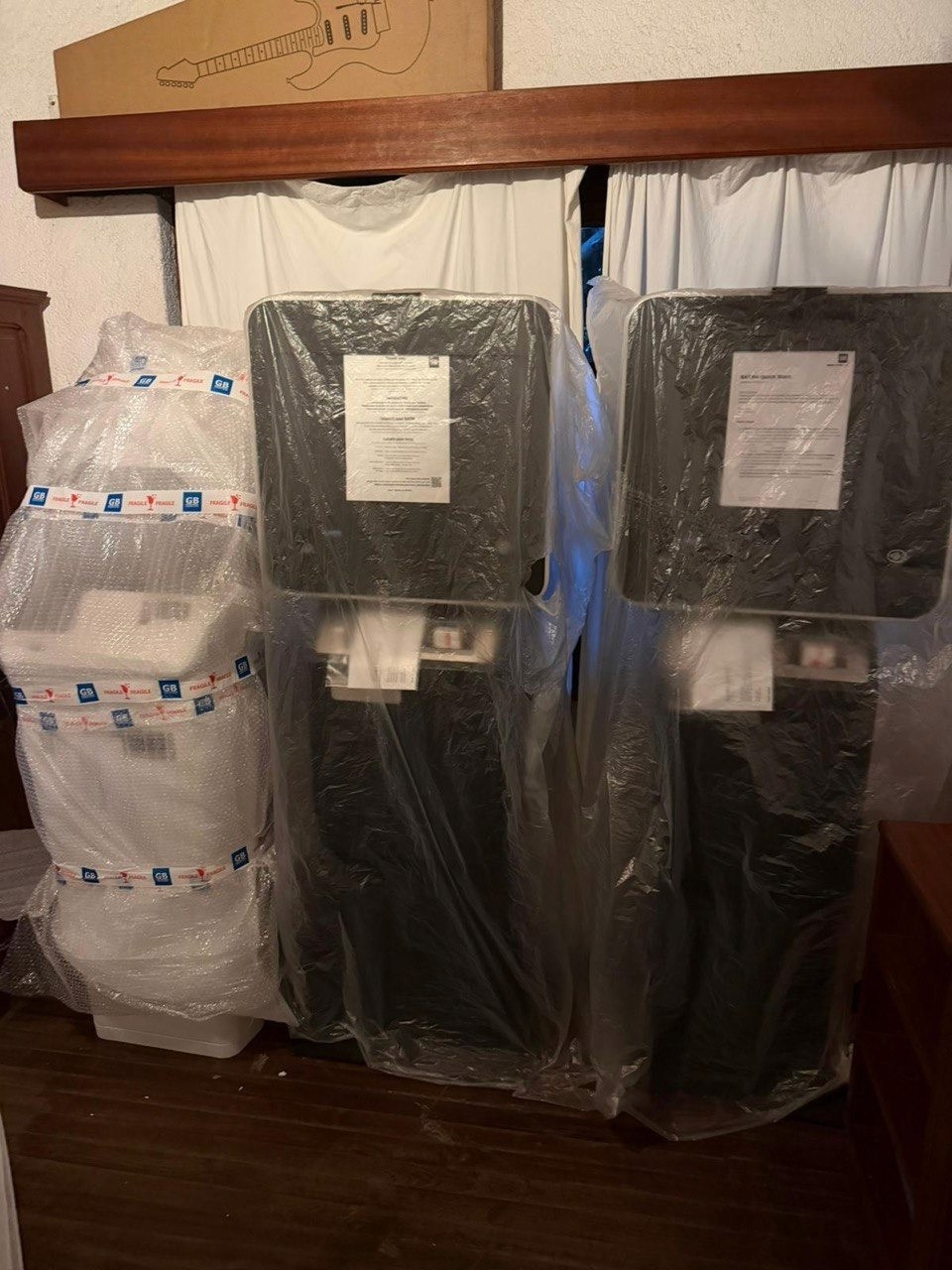
Bitcoin ATMs in Goma that haven’t yet been plugged in. | Photo courtesy of Bridge Sats
Bridge Sats Academy: This is an educational programme in partnership with six universities. It provides 500 books on Bitcoin and technology; a satellite connection; a node, a Bitcoin miner, an inter-university hackathon; and access to the Timechain Forum, a local conference headed by the aforementioned Christophe Hamisi that is dedicated to energy, entrepreneurship, and Bitcoin. The academy also organises a monthly meetup for 100 students per university. By the end of the year, Bridge Sats Academy will have organised 72 university meetups, making it one of the most active programmes in Africa.
Redblack Wines: This is a premium wine brand, launched in Kigali and Goma, Rwanda.

The selection of white, red and rosé wines that Redblack Wines produces | Image courtesy of Bridge Sats
Crypto Drying: The Bridge Sats team is currently studying with partners the possibility of drying fruit using the heat from ASIC miners (bitcoin mining machines). This project is in the early stages and is still unofficial. This idea was inspired by Gouspillou’s work in Virunga, where the heat from ASICs is used to dry cocoa that’s used to make chocolate.
“Each of our projects brings a concrete solution: access to Bitcoin, simplified international transfers, education, and aid for institutional adoption,” said Wanzavalere.
The financial services Bridge Sats offers are particularly important in the DRC, where, as of July 2022, only 26% of the active population has a bank account and only 16% has a mobile money account, according to the International Monetary Fund (IMF).
Wanzavalere also noted that Bitcoin services are particularly useful in Goma, where he currently lives, which has been cut off from the banking system for over a year now due to rebels having seized control of the city.
The dimension of Bridge Sats’ business that is currently booming the most right now is the OTC desk, which has become one of the most active desks in Goma.
“The popularity of the OTC desk proves that bitcoin is entering real-world usage,” said Wanzavalere. “We are now assisting several large companies and institutions in integrating Bitcoin as a payment method, and requests for deployment in Kinshasa, which has 18-20 million inhabitants, are multiplying, which could exponentially increase our impact.”
How Fedi Is Being Used in the DRC
Fedi has also been integrated in Wanzavalere’s approach, and he believes that it’s an essential tool for a number of people to rely on, especially when they can’t rely on traditional systems.
“While Goma is isolated from the banking system, journalists, ecological companies, and schools have understood the importance of alternatives, as existing systems can stop abruptly,” explained Wanzavalere.
While some, including the journalists Wanzavalere mentioned, can use Fedi as a communications tool, he noted that payments are the “core feature” for which many in the DRC turn to Fedi. Part of the reason for this is that people can use Fedi’s wallet to make payments via the Mini Apps that they create to solve local problems.
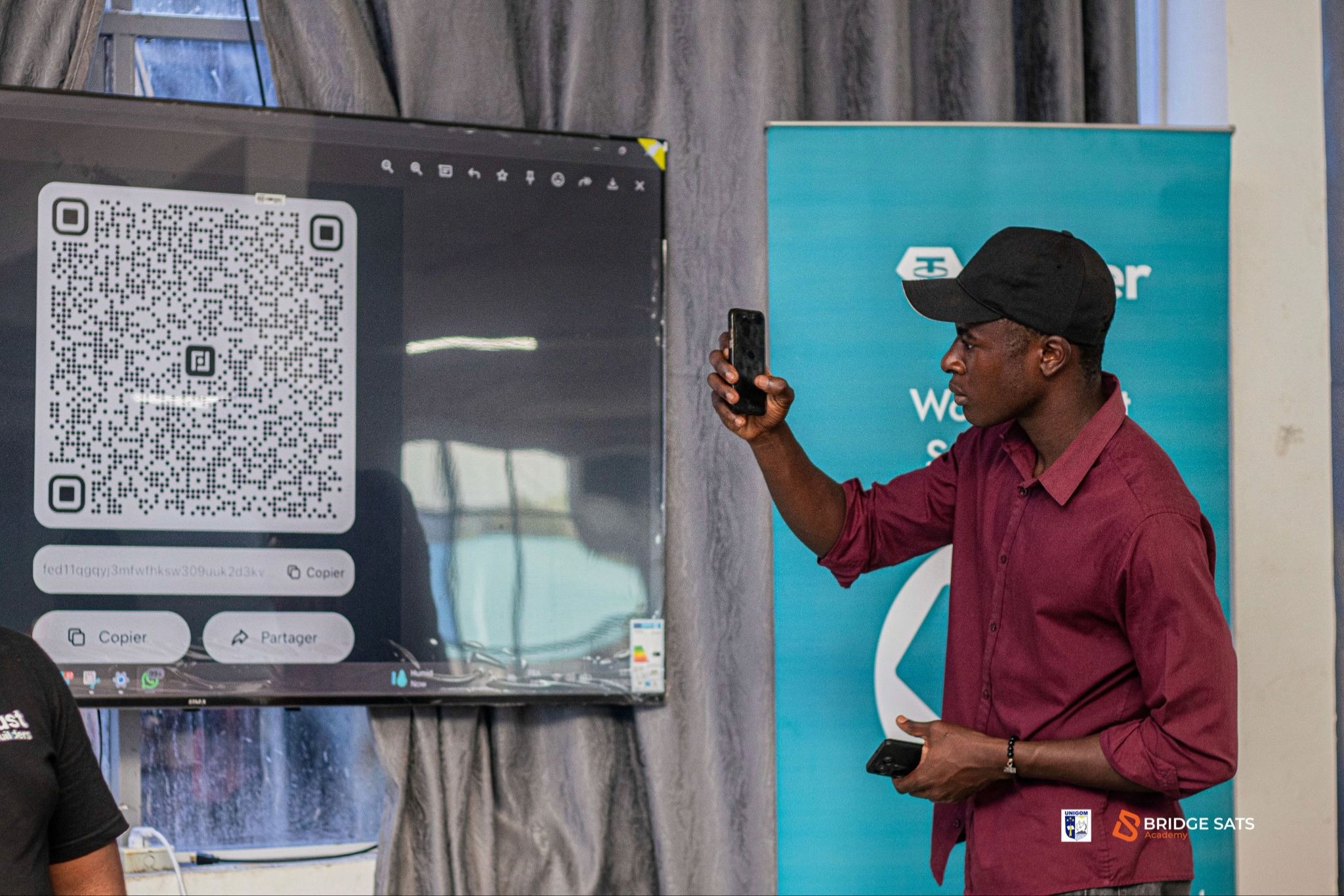
At attendee at a Bridge Sats Academy session at the University of Goma practices using Fedi | Photo courtesy of Bridge Sats
“I believe local utility applications will make Fedi one of the most used wallets,” said Wanzavalere.
He further noted that “there is also huge potential for Fedi with savings groups, a path we are already exploring with the Hodari Fund.” (The Hodari Fund is a branch of Kiveclair that helps refugee women access collateral-free loans to start small businesses.)
What is more, Bridge Sats is currently running a federation via Fedi and plans to build some of the local utility Mini Apps he mentioned.
Helping the University of Goma to Accept Bitcoin
A few weeks back, you may have seen the news about the University of Goma becoming the first university in Africa to begin accepting bitcoin payments on campus.
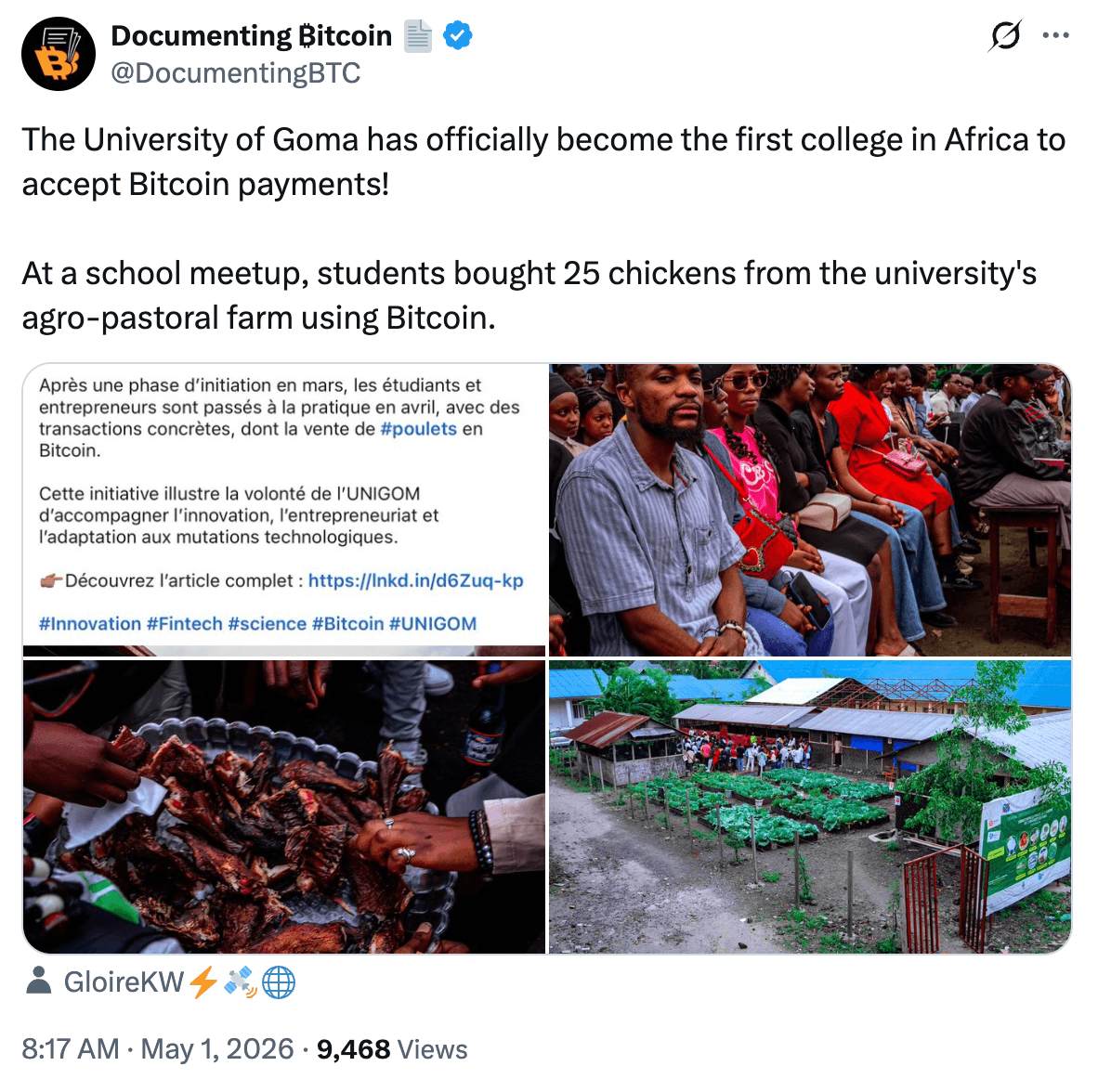
Wanzavalere and the Bridge Sats team were behind this. They’d paved the way for it beginning one year ago when they partnered with the university to launch a blockchain/AI center.
“The involvement of the university and its 6,000 students has radically changed the perception of Bitcoin in Goma,” said Wanzavalere.
Beginning on 27 March 2026, Bridge Sats began working with the University of Goma to launch a series of in-person events that helped to familiarise the students with using Bitcoin.
At the events, students practised sending and receiving bitcoin using noncustodial wallets, including Fedi. Moderators also assisted the students in using bitcoin to purchase items and services including airplane tickets, online subscriptions, and phone credits.
On 25 April 2026, at the university’s Green Lake Campus, more than 100 participants, including not just students but academic staff and entrepreneurs, practised making real transactions.
Some of these transactions included the attendees purchasing chicken as part of a meal at the event.
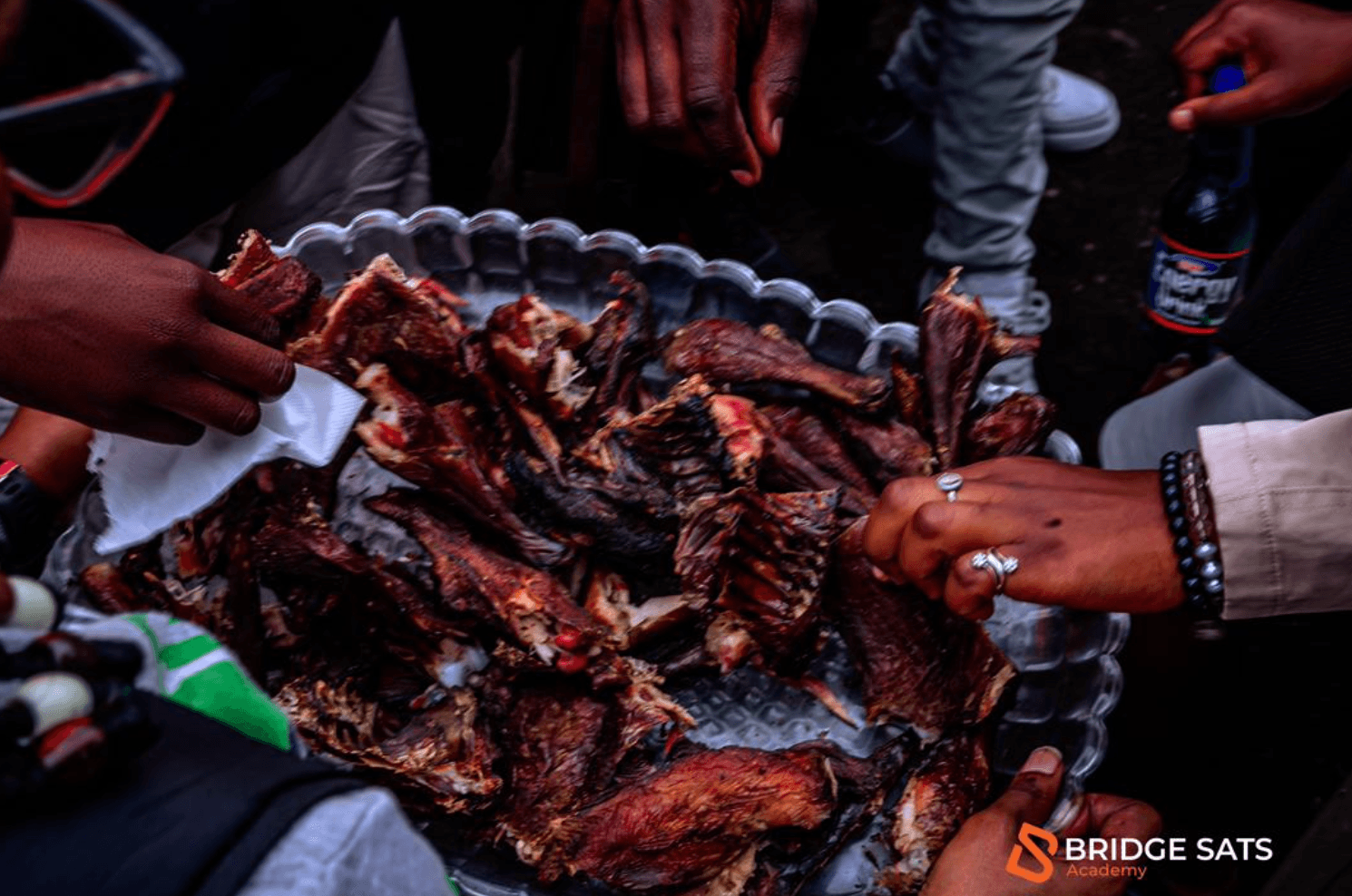
Chicken purchased at the University of Goma with bitcoin in April 2026 | Photo courtesy of Bridge Sats
Wanzavalere alluded to the notion that the university may soon begin accepting bitcoin for academic fees, as well.
“Managing academic fees in cash for 6,000 students is a logistical and security nightmare,” said Wanzavalere, who added that the University of Kinshasa, where Bridge Sats is already hosting a regular meetup, may also soon be interested in adopting Bitcoin.
What’s Next for Wanzavalere?
Outside of his work for Bridge Sats and Kiveklair, Wanzavalere has also been working on be-BOP for approximately the past two years.
be-BOP enables everyday people to create websites that natively integrate Bitcoin and fiat payments with the help of the Nostr.
“be-BOP is for ticketing, peer-funding, e-commerce, and point-of-sale software,” explained Wanzavalere.
“It’s one of my favorite projects for Bitcoin adoption,” said Wanzavalere. “It’s open-source, without any plugins, and it’s an infrastructure that prepares Africa for Bitcoin adoption. Our clients use be-BOP for their site today and can activate Bitcoin tomorrow without much of a hassle.”
Wanzavalere added that he and the be-BOP team is creating websites for local NGOs wishing to raise funds without intermediaries and for businesses that sell goods online. Approximately 50 projects are currently using this infrastructure.
The Timechain Forum and Kiveclair sites both run on be-BOP, and certain conferences and shops in Europe employ be-BOP, as well.
be-BOP was also the voting software for the Africa Social Impact Award at the Africa Bitcoin Conference 2024.
On the topic of the Africa Bitcoin Conference, Wanzavalere co-founded the event with Farida Bemba Nabourema in 2022.
While he’s proud of what the conference has accomplished thus far, he’d like to see the purpose of the conference evolve moving forward.
“The Africa Bitcoin Conference (ABC) brought together for the first time many Bitcoiners who only knew each other through social networks, fostering the emergence of joint projects,” explained Wanzavalere. “It is a journey that grows and adapts. After emphasizing the potential impact of Bitcoin, I hope that over the years, more and more concrete solutions will be presented at the conference rather than just ideas.”
If African Bitcoiners need a dose of inspiration or a model for what concrete solutions look like, they need only look to the work that Wanzavalere is doing, as he and his various teams are setting an example of what actual adoption of Bitcoin and freedom tech in Africa looks like from a small city in the northeastern region of the DRC.
“We are on the right track to make Goma one of Africa's capitals for Bitcoin and open-source software,” said Wanzavalere.
Whether he fully achieves his utopian vision is almost beside the point.
What matters is the tangible framework he's building, one ambitious project at a time, to elevate Africa's standing as a hotbed of Bitcoin adoption and innovation.
